While the United States government was shut down, the Department of Homeland Security allowed ICE to roll out ads encouraging citizens to join them on Spotify. If you use the free version of the app, you may have experienced ads interrupting your music with an eerie reminder to “fulfill your mission.”
The popular podcast and music streaming service is at the epicenter of the fire after users online took notice of the ICE commercials within the free-with-ads plan on the platform. Spotify has been on thin ice with its artists and consumers after many spoke out about their unfair pay for musicians.
The debated topic of which music streaming platform is the best has changed tones entirely since Spotify CEO Daniel Ek’s venture capital firm, Prima Materia, invested $694 million in Helsing — a company that develops AI defense technology for military use. He is now also the chairman of Helsing.

Ek’s controversial investments in AI war tech, lack of transparency about artists’ pay-per-stream and allowing ICE recruitment ads to stream through their platform has ultimately resulted in an audience shift from the mainstream services, such as Apple Music and Spotify, to new alternative platforms and physical media. Despite announcing that Ek is stepping down as Spotify CEO and into the executive chairman position on Jan. 1, 2026, stocks continue to decline as their users apply pressure to their ethics.
Alternative platforms like Bandcamp, Soundcloud and Tidal are popular services that contribute to the vast choice for music streaming. The independently owned streaming service, Qobuz, has set itself apart by being the first music streaming service to introduce high sound quality while putting an emphasis on quality user experience; it’s operated solely by humans, having only about 100 employees.
Dan Mackta, the managing director for Qobuz’ North America and Northern Europe services, says that the human-to-human experience is part of what makes Qobuz special in the streaming world.
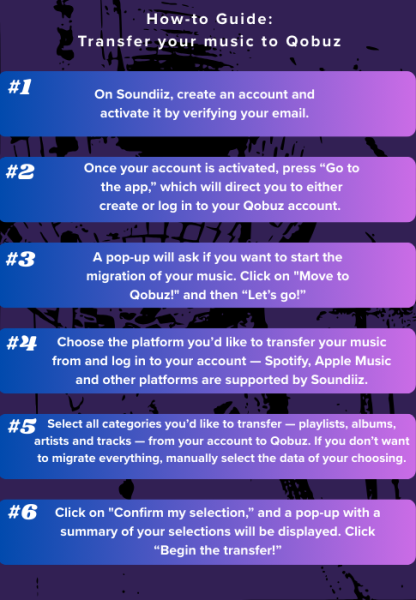
Qobuz doesn’t have a free-with-ads model. They don’t run ads at all and, according to Mackta, have no plans to in the future. “It seems like that’s a totally different business, and that also devalues the music,” said Mackta.
Mackta recalls the week in early October where Qobuz’s numbers took off following the online frenzy of people noticing ICE ads on Spotify. “Literally, that day, we had our biggest day ever of new subscribers coming in, and then the next day it was the same and then the day after that it was double,” said Mackta. Those who subscribed to Qobuz signed up for a month-long free trial, which then subscribes them to a monthly plan starting at $10.83, or $4.99 for college students 25-years-old or younger.
Mackta emphasizes that ethics and transparency are valued at Qobuz, stating that, compared to other platforms, they pay their artists the most per stream. “We’re the only service — full catalog streaming platform that has actually published the average per stream rate.” He also shared that they are currently working on a policy for AI to address the recent rise of AI generated music, ensuring those tracks are detected and not recommended as to not take away from human artist’s royalties.
“By its nature, music as an art form, is something that brings together — when it’s working right — people of every imaginable background.”
A Bay Area band called Goof has had an outwardly spoken anti-Spotify stance online in response to the news of Ek’s ties with Helsing, which broke out in June. The band has since removed all but one song titled “Fuck Spotify” as a farewell, which, by the time of publishing, will have also been removed from the platform as they transition to a one-dollar-per-month Patreon account to distribute their music. “This AI warfare is going to be turned against us one day,” said Goof band member, Ahmed Amer Elsayed. “And it’s going to be turned against the people I love in Egypt and Palestine and other places.”

For Goof, deciding to remove their music from Spotify was an easy decision.
“It’s like the McDonald’s of the music industry,” said Taylor Martin, the drummer. “It’s not hard when it’s shit.”
Other artists have also removed their music from Spotify as a result of the CEO’s stance on AI war tech, including well-known psychedelic rock band King Gizzard and the Lizard Wizard.
Shane Lawton, a bassist for The Helltones, describes his Bay Area band’s sound as “retro rock vibes.” While his band remains on all streaming services, his personal take led him to cancelling his own Spotify subscription two years ago and making the switch to Youtube. Lawton has been trying to convince his own band to remove their music from Spotify, however the platform’s popularity with their fans keeps them on the platform for monetary purposes.
“These companies should have ethical practices, but there’s almost no ethical consumption under capitalism to begin with,” said Lawton.