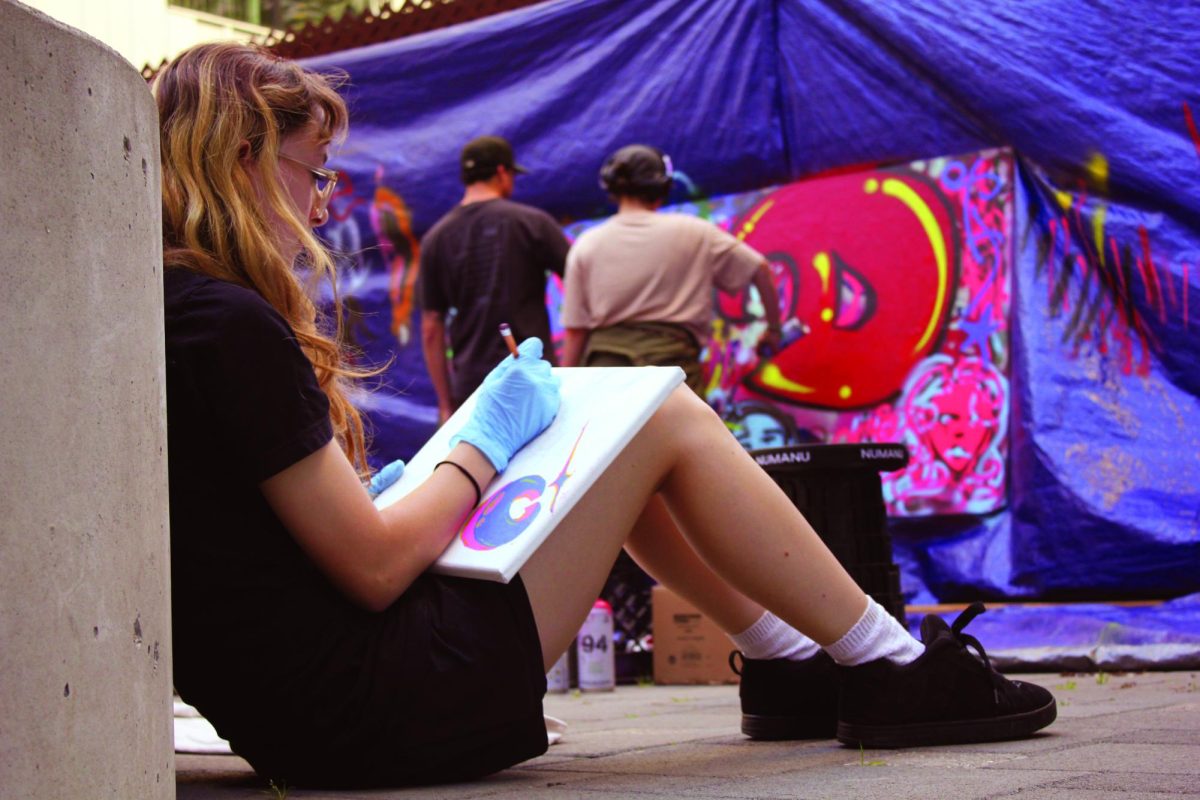
Margaret Martinez steps past a wall layered in paint — tags over murals, colors bleeding into one another, some fresh, some fading. She sees public art as something that brings the street to life, adding color and character to spaces that might otherwise feel overlooked.
“I think it shows people live here. It shows signs of life. Otherwise it’s just boring,” said Martinez about having public art in San Francisco. “That’s kind of the culture of the city: We’re going to keep making things, and even if you’re going to cover it up, we’re going to keep doing it.”
Across San Francisco, murals, tags and other forms of public art are woven into the city’s everyday landscape.
Big Art Loop, a public art initiative funded by the Sijbrandij Foundation, plans to install up to 100 new large-scale works across the city in the next three years. At the same time, the city’s Civic Art Collection already includes more than 4,000 publicly accessible works installed across parks, libraries and transit spaces. A little over a decade ago, that number was closer to 3,000, according to a 2010 San Francisco Arts Commission district report, reflecting the steady growth of public art across the city.
Public art in San Francisco is expanding — not just in scale, but in purpose. The visibility and intent behind some artist’s pieces communicate a more layered story, where each piece may mean something different to the person encountering it.
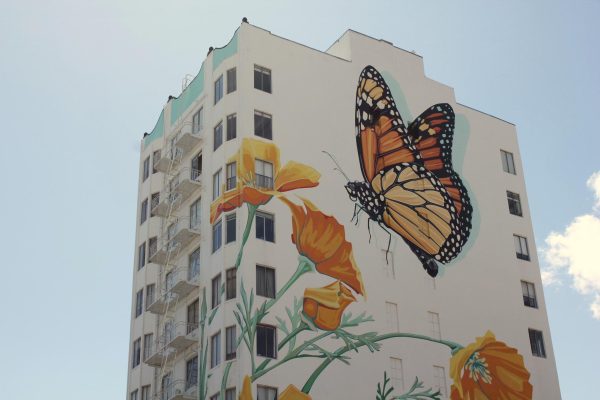
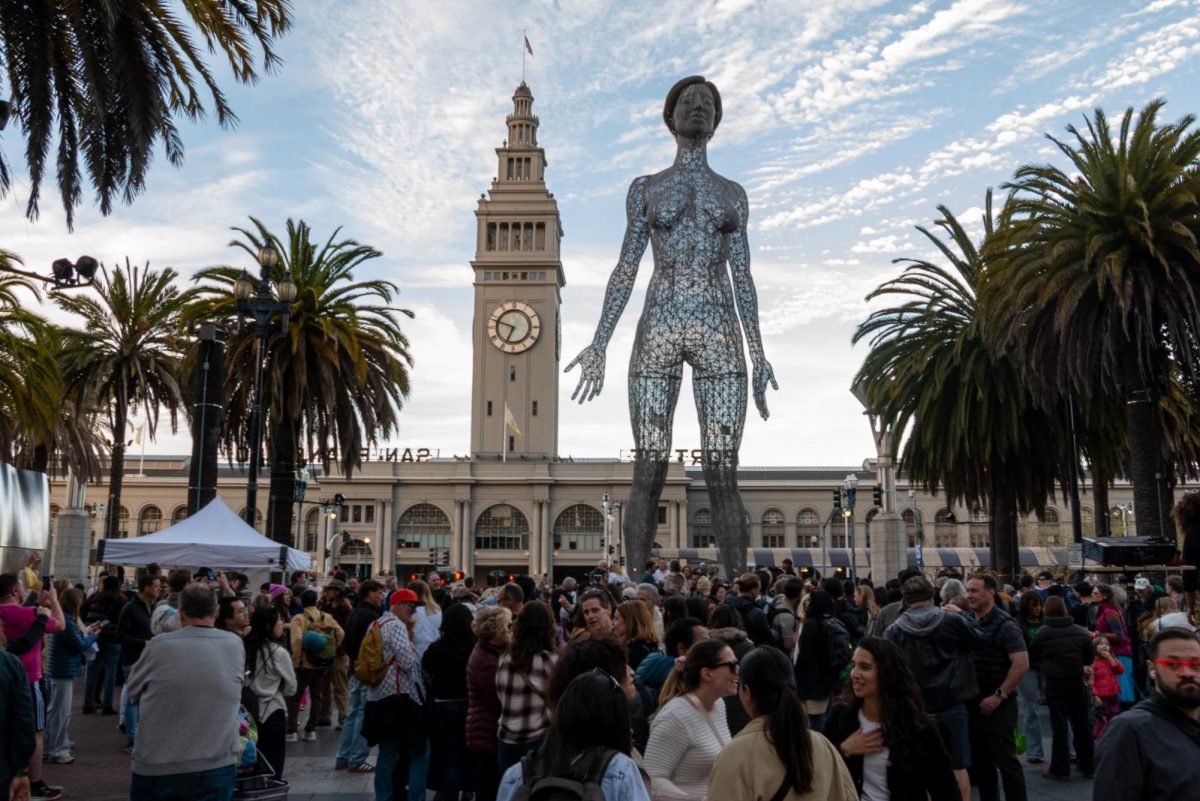
Sculptor Marco Cochrane’s work centers on creating sculptures that offer women a sense of safety — spaces where they can pause, reflect and feel at ease within their own bodies. Sculptures like Cochrane’s R-Evolution — a towering steel-mesh woman in Embarcadero Plaza that illuminates at night — aren’t meant to blend in. Instead, he said they’re meant to pull people in, then push them into a harder conversation.
“What would the world be like if women were safe?” said Cochrane. “I feel like my job is to notice what’s going on in the world and try to balance it.”
This approach, creating work that can be understood without prior knowledge and inviting personal interpretation, reflects a broader pattern in San Francisco’s public art, where pieces draw people in visually before a deeper meaning’s presented.
Cochrane’s work centers on large-scale steel sculptures of women placed in public space, which he says are designed to make the body, and invisible experiences, visible. “If we’re not talking about this, how can we ever fix it?” said Cochrane, referring to gender-based violence and safety in public spaces.
San Francisco painter and muralist E Dyer creates public art in the city’s overlooked neighborhoods, specifically the Tenderloin. Dyer’s art draws from historical events, such as her mural “Your help, your hands, and your hearts are always needed” which is inspired by the Compton’s Cafeteria Riot — a 1966 incident where a transgender woman was harassed by a police officer for cross-dressing and, as the community came to her defense, resulted in a protest. But Dyer said that knowing the piece’s historical background isn’t necessary to engage with it: “I try to make these pieces in ways that people can read them without having that kind of understanding.”
Director of the School of Art at SF State, Santhi Kavuri-Bauer, highlights that there are gaps, which he describes as “missed opportunities,” in what gets commemorated. He highlights that many important moments in the city’s history remain underrecognized.
Those gaps suggest that access isn’t just about physical presence — it’s also about whose stories are visible enough to be noticed in the first place.
SF State Arts Professor Michael Arcega contextualizes that tension through everyday experience.
“We’re so inundated with this attention economy. Everything is trying to grab our attention. We need these moments that break us from that; that’s not trying to sell us anything, just a moment of reflection,” he said.
For Sierra Weiler, a studio art major at SF State, public art offers a form of access that doesn’t rely on admission or exclusivity.
“The city is defunding and shutting down these public, cooperative spots for artists to go and work in, and that’s just harming the future of education for younger artists,” said Weiler.
This idea of visibility and whose stories are seen is something multidisciplinary artist and architectural designer Raylene Gorum considers in her approach to public art. She looks closely at the history of a place and works to reflect it through what she creates.
Her projects begin with researching the history of a site and are designed to reflect its surrounding context, whether that be a previous building owner or the neighborhood’s past. Her work then takes shape through those details that are captured in the final piece.
“I love when you don’t have to go to a museum … it’s just integrated into daily life,” said Gorum.
Public art, she added, creates interaction. “People just naturally gather towards art pieces like moths to a flame … they’re markers of space and conversation and engagement,” said Gorum.