It was supposed to be like any average day. Driving down the streets of Santa Rosa, with her itemized grocery list and kids buckled in the back seat. But, out of her peripheral vision she notices a truck tailgating her. After several miles pass, she pulls into a store’s parking lot. Moments later, she’s berated and yelled at. The reason? Her bumper sticker of a cartoon cat that reads “Harris-Walz.”
Her husband Ted, who withheld his last name due to concerns over workplace retaliation, doesn’t take this incident as random aggression. To Ted this represented a wave of extremism emboldened by the increased intensity of a polarized political climate in the U.S. In response, he bought a gun.
Ted is no revolutionary. His driving philosophy is conflict avoidance. The only other firearm he’s ever purchased was a shotgun on his 18th birthday, which has collected dust in his closet ever since. But because of today’s political climate, Ted recognizes an increased need to protect his family.

“If a government agency is coming after me — nothing I can do,” said Ted. “But if there’s individual wackos out there who see this as a presidential mandate — that they’re serving their country by coming after liberals or people who disagree with them — then that’s where I see the line for me.”
Ted’s not alone in his fears. A 2025 Pew Research Center study found that 85% of Americans believe politically motivated violence is increasing.
There’s been an increased interest in people wanting to learn how to shoot as a result of the current political climate, said Thomas Boyer, spokesperson for the San Francisco chapter of the Pink Pistols, a gun group whose mission is to reach the LGBTQ+ community with firearms education.
In today’s political landscape gun ownership is becoming increasingly more palatable to both the right and the left. According to the Firearm Industry Trade Association, there were approximately 26.2 million new gun owners from 2020 to 2025. But, a 2016 Annals of Internal Medicine study on “Homicide Deaths Among Adult Cohabitants of Handgun Owners in California” found that people living in homes with guns face substantially higher risks of dying.
This reality extends into SF State’s own backyard. In March of 2026, 22-year-old Samantha Emge, an SF State alum was allegedly accidentally shot and killed by her boyfriend who was later charged with involuntary manslaughter. While not an act of political violence, the incident shows that when guns are present, the results can be deadly.
A Growing Distrust
“You don’t know who’s going to do it. You just know that, over time, somebody will,” said
Emily Gorcenski, a technologist and activist in Charlottesville, Virginia. Gorcenski has years of experience tracking the movements of far right extremists.
She explained that violence perpetrated by far-right extremists is rarely due to direct orders from centralized groups with a clear chain of command. Instead, far right groups create an aura that glorifies violence and wait for individuals to be influenced to independently act.
Gorcenski explained that far-right ideology that once existed on the fringes has become increasingly normalized and infused with mainstream conservative ideology.

For one transgender gun owner, who requested anonymity for safety reasons, the current political climate has changed her view of her own personal safety.
“I fear how I’ve become far more callous with it [owning a gun in the current political climate] than I ever want to. And it’s likely because the world hates me so much. It’s not because I hate people, it’s because I feel like I’ve been calloused by the people around me. And so my view of defending myself has become far more absolute,” she said. “It scares me a little.”
A 2026 research study from the UCLA Williams Institute found that transgender people are at a disproportionately higher risk of violence.
For her, she is distrustful that the government will protect her. She pointed out that police officers have no legal duty to defend you according to a longstanding supreme court precedent.
“If cops aren’t going to defend you, you got to defend you,” she said.
A study of protests in the U.S. from 2020-2021, done by Indigo Koslicki et al. and published in Policing & Society, found that police were far more likely to use force during left-wing protests compared to right-wing protests, despite right-wing protests having a higher degree of weapons presence and aggression towards police.
“I think it’s a natural reaction to a growing distrust in the state in being able and willing to defend civil rights and human rights as an interest,” said Gorcenski. “A lot of people on the left have sat and watched violent neo-Nazis be protected by the police while those violent neo-Nazis are committing illegal violence themselves.”
A report from the National Institute of Justice — that has since been removed from the Department of Justice website, despite results aligning with other independent studies — found that far-right extremists have killed more Americans than any other politically or religiously motivated group.
Operation Metro Surge
For Matt Harris, a Minnesota resident, distrust in governance is very real. In January, Harris was detained by federal officers while attempting to document what he believed to be an unlawful Immigration and Customs Enforcement (ICE) operation in his private property community.
“I got four or five vehicles and people armed to the teeth screaming and yelling at me, and I haven’t done anything,” said Harris. “They told me I was going to jail because I was following them. I told them that wasn’t a freaking crime. They told me I was going to jail for obstruction.”
Harris was then yanked from his vehicle, thrown on the ground and transported to a federal building in Minneapolis where agents discovered his legal concealed carry firearm.
The incident occurred during Operation Metro Surge, which saw the deployment of an estimated 3,000 to 4,000 federal immigration enforcement agents across Minnesota and the shooting of three people by federal agents, two of which resulted in death.
“I looked at my wife and said that could’ve been me,” Harris said after hearing of the shooting of Alex Pretti, an ICU nurse who was shot and killed by ICE agents during a protest in Minneapolis while legally carrying a concealed firearm.

Last Resort
At SF State, psychology student Daniel Marnach, originally became a gun owner at age 18 out of pure fascination with them. However, he said he’s seen a surge of first-time gun owners, namely on online spaces like Reddit.
“I’ve definitely become more active about it as a tool for minority self-defense since seeing how violent things have gotten,” said Marnach, accounting for the safety of both him and his girlfriend who is transgender.
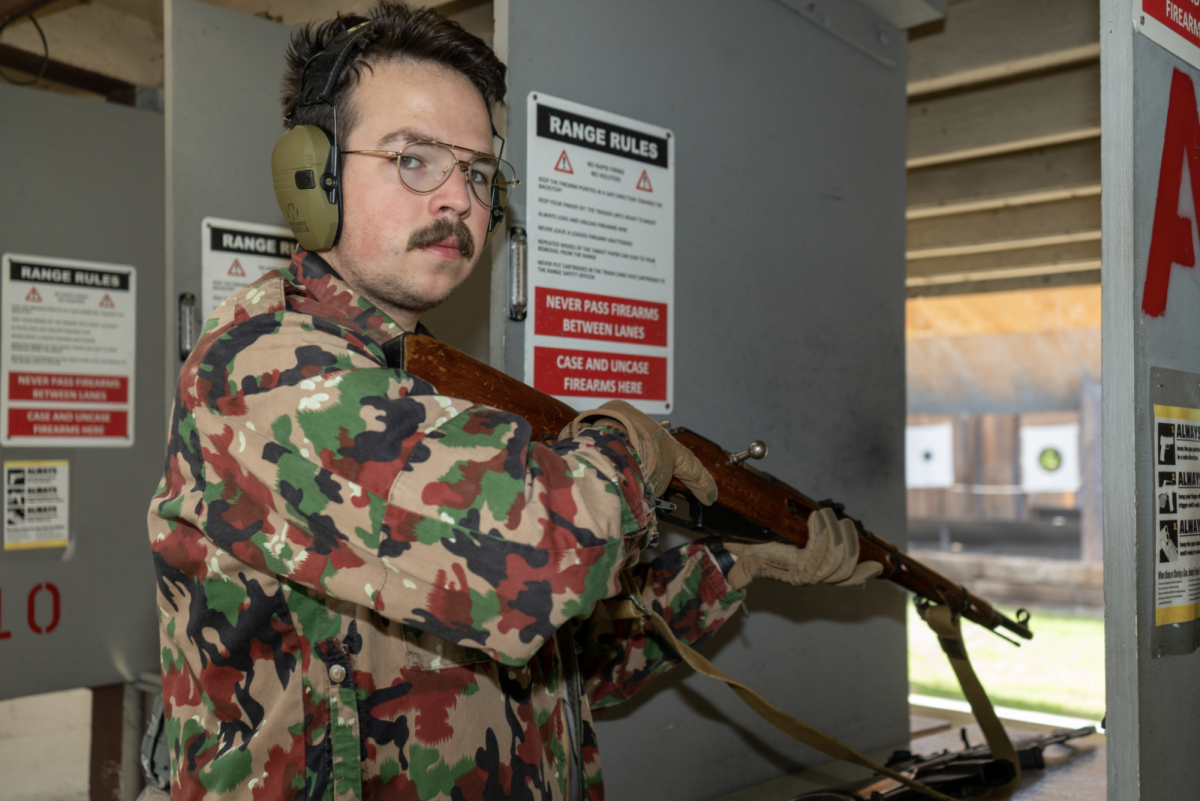
Gun owner and Oakland resident Devin Jacobsen has seen the current political climate change conversations about guns in his own home. As of recently, his wife, who was previously opposed to having firearms in their home, has joined Jacobsen at the shooting range — something he said encapsulates the political anxieties many are feeling.
Jacobsen doesn’t walk around armed. In the case of a robbery he would rather hand over his wallet than take a life. But in an era of deepening political uncertainty, he has made peace with potentially having to use his weapons in a “last resort” scenario where the state is no longer willing to uphold any semblance of a civil society.
“I think when violence comes to you, as we have seen over the last year … having that ability to meet violence with violence may be necessary. The tree of liberty is fed with the blood of patriots and tyrants,” said Jacobsen. “I think more people are coming to that conclusion — this idea that nobody is coming to save us.”