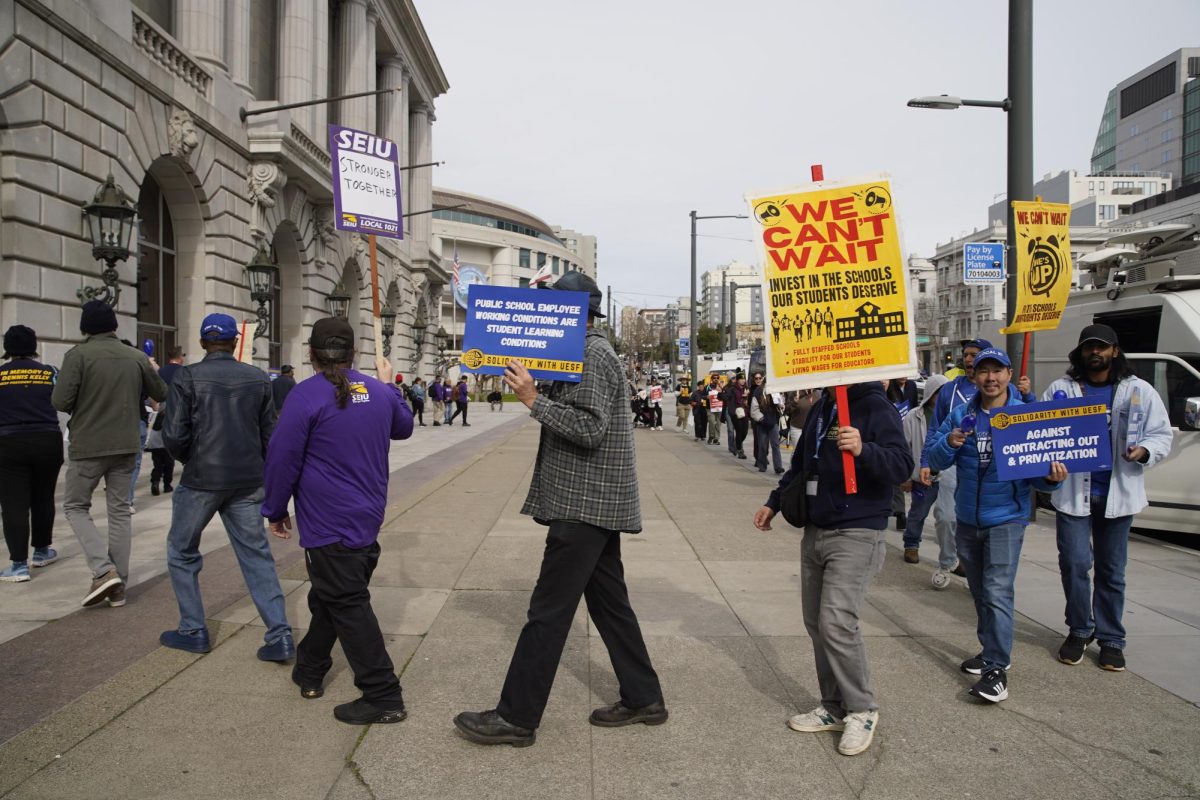
On May 30, 2020, thousands of peaceful protesters filled the streets of San Francisco following the death of George Floyd at the hands of Minneapolis police. That night, shortly before 9 p.m., a group of people began looting stores, vandalizing property and rioting from Union Square down Market Street, according to a letter by Chief of Police William “Bill” Scott for San Francisco’s Board of Supervisors.
Seeing this civil unrest as a threat to the safety of protesters, residents and first responders, the San Francisco Police Department (SFPD) was quickly granted access to privately owned surveillance to investigate the unrest. SFPD didn’t just have access to the crime footage, they were able to monitor all activity in the area, including peaceful protests, too.
While there has been a nationwide decrease in crime over recent years, AI-driven surveillance is spreading rapidly. In San Francisco, the SFPD credits a 30% drop in overall crimes in 2025 due to their expansion of surveillance technology throughout the city — and they don’t plan on slowing down anytime soon.
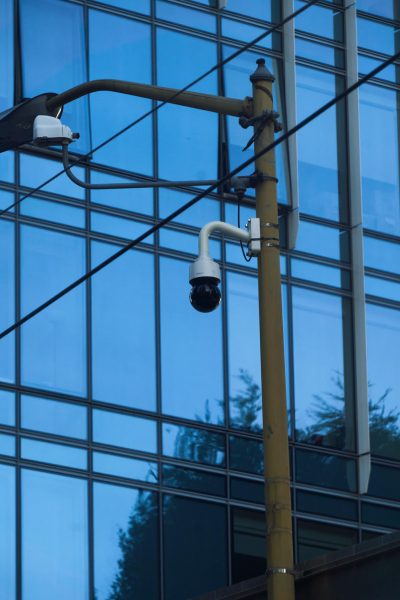
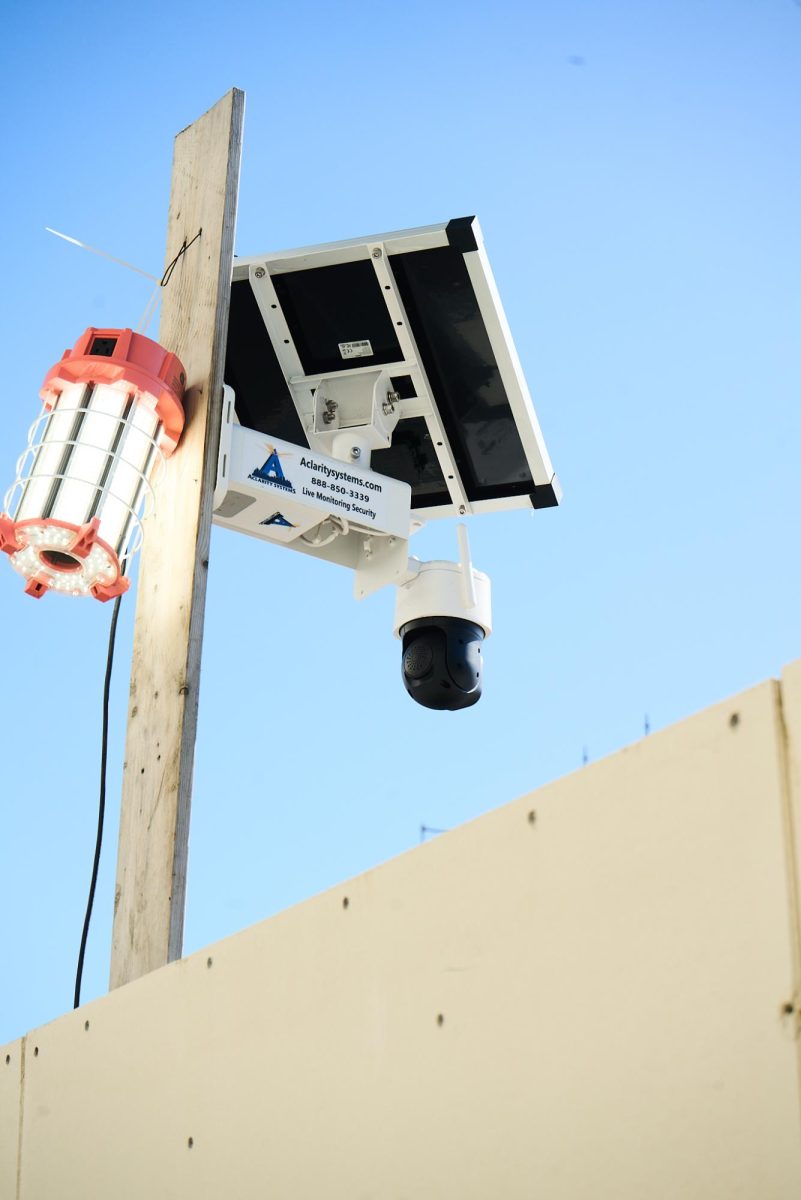
The expansion of SFPD surveillance tech includes drones, LiveView Technologies’ mobile security units, Flock Safety Automatic License Plate Readers (ALPRs) and public safety cameras. The surveillance data feeds into SFPD’s Real-Time Investigation Center (RTIC), an intel hub where the police utilize their technology to combat crime remotely.
Proposition E
March 2024 San Francisco ballots summarized Proposition E as a measure to: reduce recordkeeping and reporting requirements, authorize the use of drones, install public surveillance cameras without further approval and authorize new surveillance technology unless the Board of Supervisors disapproves. This gave the SFPD the opportunity to use new surveillance technology at their discretion in order to reduce crime in the city.
San Francisco voters’ concern for public safety in 2024 narrowly allowed for Prop E to pass in 2024 with 54% in favor. The proposition was backed by former mayor of San Francisco, London Breed, and has been supported since by current mayor, Daniel Lurie.
According to the SFPD website, public safety cameras are defined as “any digital recording surveillance system installed at fixed locations in an open and obvious manner by the City and County of San Francisco to record public streets, sidewalks, or common areas of public housing complexes to enhance public safety.”
Prop E allowed SFPD to install public safety cameras in places where the chief of police decides they would improve public safety based on crime data, after holding a public meeting under Section 19.4(b) of the Public Safety Camera Ordinance. Under current Chief of Police Derrick Lew, the first cameras were placed in the Mission District on 16th and 19th streets.
In order to implement Prop E’s new policies and technologies, which produced more police presence and surveillance on the streets, the SFPD introduced “Department General Orders” and Mayor Breed supported it with a $3.7 million budget.
Surveillance in San Francisco
San Francisco wasn’t always in favor of mass surveillance. In 2019, the city passed a policy prohibiting law enforcement from using facial recognition, becoming the first major city in the U.S. to do so.
However, in 2020, the Electronic Frontier Foundation (EFF) represented the plaintiffs, a group of activists, in suing San Francisco. The plaintiffs argued that the SFPD accessed footage of a Black Lives Matter protest through the Union Square Business Improvement District’s surveillance network without obtaining permission from the city’s Board of Supervisors.
“San Francisco went from being a pioneer in responsible ways of controlling surveillance and protecting people’s privacy to one of the most surveilled cities in the country with very few guardrails, in just a few short years,” said Matthew Guariglia, senior policy analyst for EFF.
In 2022, the Board of Supervisors passed a 15-month program granting SFPD more access to non-city entity surveillance cameras with a 4-7 vote. This allowed SFPD access to live video streams from private cameras for the purposes of investigating crimes.
Guariglia said that crime ebbs and flows due to complicated reasons concerning the economy, education, housing, health care, city design and planning.
“Police are able to say now that there was a drop in crime in San Francisco because of their drone program, but they don’t account for the fact that crime has been dropping nationally,” said Guariglia. “There is never really a real way to prove that crime falls because of surveillance.”
Guariglia explained that the city began a multi-year political campaign funded by wealthy people in the city to undo the protections against police surveillance. Prop E is part of that political move, said Guariglia. Venture capitalists Ron Conway and Jeremy Liew and Twitch co-founder Emmett Shear all invested in Prop E.
In June 2025, Lurie announced that a $9.4 million donation from Chris Larson, a crypto billionaire and co-founder of Ripple Labs, would be funding an expansion and relocation of the Real Time Investigation Center. The intel hub is located in the Financial District at 315 Montgomery St., in Ripple’s main office to support the vast expansion of surveillance in the city.
Larson had previously donated $250,000 to Mayor Breed’s committee supporting Prop E in 2024. He also invested nearly $4 million in cameras for Community Benefit Districts in 2020 — the same surveillance systems that SFPD gained access to that same year.
The Community Benefit Districts, also known as Business Improvement Districts, are defined by SF.gov as “a public-private partnership in a specific geographic area that funds services like cleaning, safety and economic development to improve the neighborhood’s quality of life.”
“They’re [SFPD] stripping the Board of Supervisors ability to put checks on the police away, and they’re taking orders from a billionaire who’s willing to write checks only for more surveillance,” said Guariglia.
According to EFF, some of the most surveilled neighborhoods in the city include the Mission District, Bayview, South of Market and the Tenderloin.
“The reality is it’s not just about detecting and stopping all crimes in all areas,” said Brian Cox, a San Francisco-based public defender who specializes in police accountability work. “We have seen historically with SFPD that they leverage technology and they target certain geographic areas or certain groups.”
The SFPD and Center for Policing Equity’s National Justice Database City Report states: “Black residents were estimated to be nearly 19 times more likely to have force used on them compared to White residents in the same neighborhood, and Latinx residents were almost twice as likely as White residents.”
According to SF.gov, in 2024, officers in the RTIC assisted in more than 500 arrests, stating that they “helped prevent numerous police pursuits by following suspects at a distance and making strategic arrests that reduce risks to the public.”
Former Chief of Police Scott said in an article released by SF.gov last year, “Our hard-working officers can continue to drive crime down by identifying and arresting offenders as quickly as possible.”
Cox said that there are evidence-based solutions when it comes to helping people involved in the system like housing or healthcare, rather than focusing on surveillance tactics.
“You go to any wealthy enclave in the suburbs and you can see that their needs are met,” said Cox. “They don’t have the same issues that people who cycle in and out of the courthouse do, because their needs are met.”
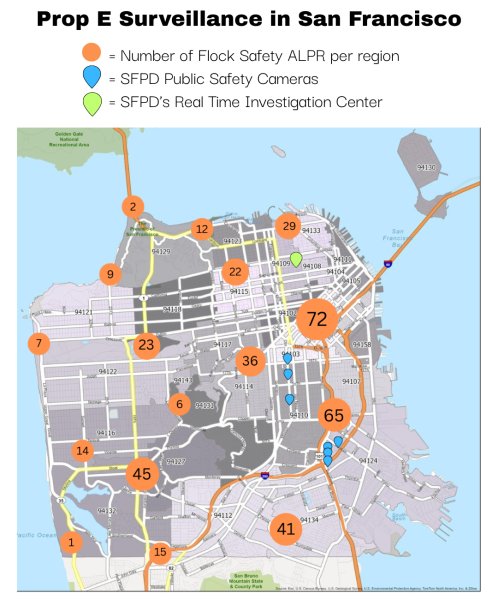
Flock Safety ALPRs
In March 2024, the city contracted Flock Safety to install and maintain 400 cameras across 100 intersections as part of Prop E’s effort to address retail and motor vehicle theft. Flock provides AI-powered automatic license plate reader technology to law enforcement agencies and neighborhood associations.
Michael Moore is a resident of San Francisco who filed a federal class-action lawsuit in December 2025 against the City and County of San Francisco over the use of Flock ALPRs. He argued that the growing number of surveillance in the city goes against the Fourth Amendment.
With the use of drones, ALPR and other surveillance systems, Cox said he questions if this technology could increase incarceration without clear evidence that it improves public safety. “These tools are going to expand the capabilities of the department, where the department focuses its attention disproportionately on people of color.”
By June 2024, SF.gov reported that even with only a fourth of the cameras installed, the ALPR system had already helped lead to arrests.
The San Francisco Municipal Transportation Agency, which oversees Muni transit, traffic, parking, bicycling, walking and taxis, has also expanded its use of ALPR technology. On May 1, 2026, the agency announced that ALPRs reduced speeding by 79%.
“We’re letting the police be testing grounds on communities of color for these tools — while private sector companies are in the background ranking in the profits, collecting all the data and doing god knows what with it,” said Cox.
According to the Flock Safety website, data is stored securely with “end-to-end encryption” and is automatically deleted after 30 days. Flock’s ALPR system allows the option of data sharing between 4,800 agencies contracted with them, giving police access to surveillance across the country.
DeFlock is an organization that is using an open-source map of Flock cameras nationwide with 94,656 cameras reported and located, and the number keeps growing.
According to their mission statement, DeFlock’s purpose is to raise awareness about the threats ALPRs pose to personal privacy and civil liberties.
In 2025, tech news outlet 404 Media revealed local law enforcement agencies nationwide conducted immigration-related searches through Flock’s ALPR network, allowing U.S. Immigration and Customs Enforcement (ICE) to access the system through the police. SFPD was one of the agencies who shared data from ALPRs with out-of-state police departments and ICE.
In some cases, the use of ALPR has led to stalking by police officers and misidentification. In 2009, SFPD held local resident Denise Green at gunpoint and handcuffed her after an ALPR misread her car’s license plate, resulting in a lawsuit for the city and SFPD.
Last year, according to a testimonial she gave CBS, Colorado resident Chrisanna Elser recorded local police on her doorbell camera accusing her of stealing a package after officers misidentified her through Flock’s ALPR system.
“These are incredibly powerful tools, and I don’t think the broad public at large has a clear understanding of how they’re using them,” said Cox. “I’m tired of sacrificing people of color on the altar of technological progress and public safety.”
Drones
The passing of Prop E marked the first time SFPD has had access to air support since 2000. As of March this year, SFPD has acquired 98 drones in total since Prop E’s passing. According to SFPD’s drone flight log, the drones have been used in flight 5,363 times since 2024.
SFPD’s drone section states: “Drones have multiple public safety benefits for the city of San Francisco, including faster response times, increased situational awareness for officers, more precision, the ability to integrate with other technology, and many other uses.”
California Assembly Bill 481 went into effect Jan. 1, 2022 and requires law enforcement to gain approval from the city’s Board of Supervisors to acquire or use designated military equipment. The bill also enforces departments adopting public policies and publishing inventory lists in the scenario where they are granted permission to use military equipment. AB 481 defines military equipment as, “Unmanned, remotely piloted, powered aerial or ground vehicles.”
John Lindsay-Poland is the co-director of American Friends Service Committee’s California Healing Justice Program. According to his biography, Lindsay-Poland’s work also includes local legislation on militarized equipment used by police in Oakland and Berkeley.
Lindsay-Poland said he submitted a complaint to the San Francisco Department of Police Accountability about SFPD obtaining drones in violation of AB 481. He explained that the SFPD did not publish their annual report on time. The San Francisco Department of Police Accountability closed his request with no explanation.
“The department is just ignoring the requirements of the law and of oversight in acquiring the drones that they got,” said Lindsay-Poland. He explained that Prop E does not exempt the city from abiding by the state law, like AB 481.
According to Section 961.2 of the Police Department Policies and Procedures, the SFPD must annually report to the San Francisco Police Commission on the total number of vehicle pursuits and the reason for the pursuit.
Lindsay-Poland says SFPD skipping state requirements on drones affects communities by turning people away from participation, saying it marginalizes communities.
“It’s all the more important that law enforcement be subject to civilian oversight and to community comment and civilian control, because they are authorized to, and they do, take people’s lives,” he said.
With mass surveillance on the rise and checks and balances in limbo, concerns for civil liberties in San Francisco grow.
“We have to not only hold law enforcement agencies accountable for the laws that govern their behavior, but also hold elected officials accountable for making law enforcement accountable,” said Lindsay-Poland.