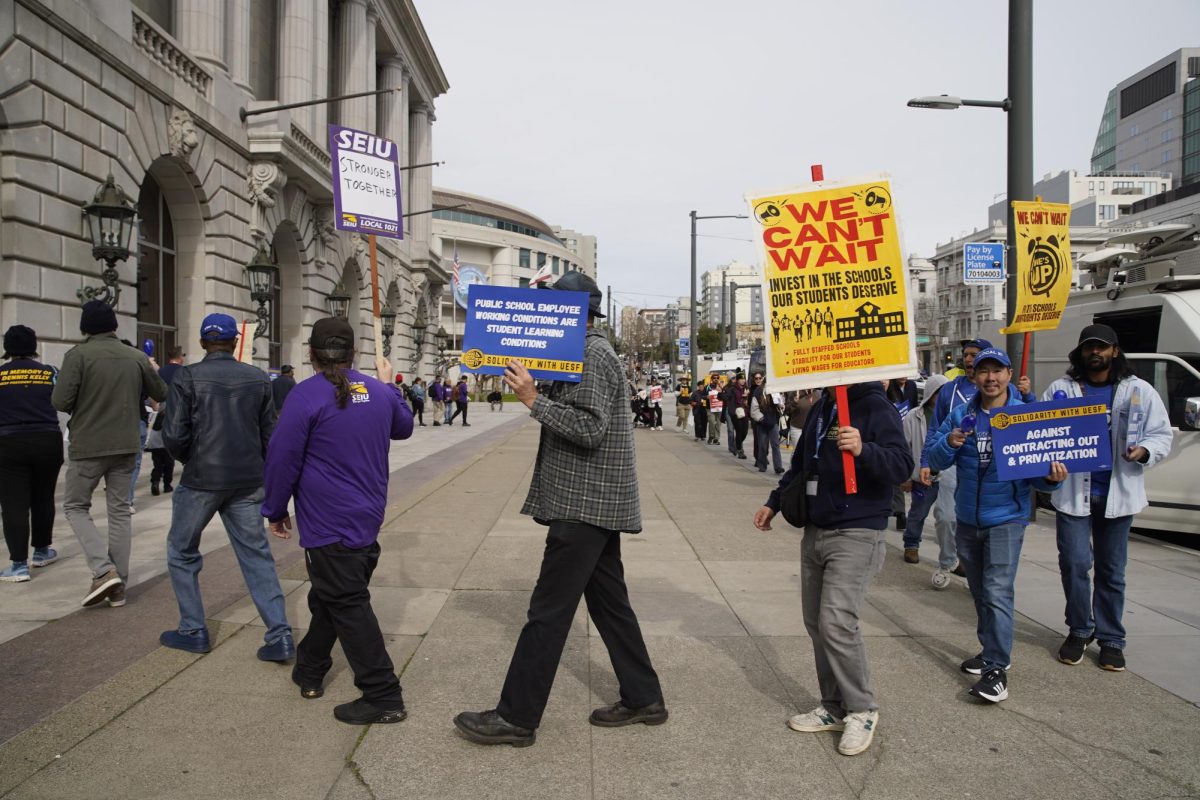
10:30 a.m. usually signals a break for recess, but instead, in San Francisco hundreds of schoolchildren picketed alongside their parents, teachers and classmates demanding improved working conditions and raises for their teachers — they had had enough.
Following failed negotiations between the United Educators of San Francisco (UESF) and the San Francisco Unified School District (SFUSD), thousands of educators went on strike, demanding full family healthcare coverage, raises — 7% for teachers and 9% for paraeducators and other classified staff — and improved working conditions.
“They haven’t offered a reasonable, fair contract,” said Mathew Schwartz, a social worker for SFUSD’s central office. He said the superintendent, Maria Su, did not put enough effort into negotiations, which began in March 2025, leading up to the strike.
With classes cancelled, hundreds of students, along with their parents, demonstrated alongside UESF at City Hall. Nearby, other children gathered in the Civic Center playgrounds, chasing each other in a game of tag, as parents struggled to find childcare.
“I’m lucky because my job allows me to work from home,” said Caya Schaan, a therapist who brought her children to the rally at City Hall. “Most parents I’ve talked to are in full support of the teachers.”
Leslie Simon, a retired educator who taught at City College of San Francisco for over 40 years, said the current tax system is to blame for academic institutions’ fiscal crises.
“[Schools have] deteriorated because the wealthy are not paying their fair share of taxes.”
On Feb. 13, UESF and SFUSD agreed on a two-year tentative deal including full family health coverage, raises — 8.5% spread over two years for paraeducators and 2% spread over two years for teachers — and, while no specifics were outlined, improved working conditions for special education paraeducators, who also received an extra 5% raise.
SFUSD’s budget deficit may look familiar. It mirrors SF State’s projected $7 million deficit and the California State University’s $2.3 billion deficit, underscoring the downward trajectory of California’s education systems.
As the erosion of institutions like health care and education impact people’s day-to-day lives, overall discontent is on the rise; including among SF State students.
“It’s tough to find … staff on campus because there’s so many hour cuts,” said Asian American Studies major Youngmin Rooham, explaining his frustration following SF State budget cuts. While he’s assured there’ll always be universities to attend, he worries SF State, and other schools like East Bay, may soon fade away.
“I would hope that this institution survives long enough for them to see it.” Rooham said, thinking about his future children.
Simon suggests that reforming corporate tax cuts could alleviate financial pressures placed on educational institutions and level out the tax burden among Californians.
“Let the corporations pay their fair share,” Simon said.