The fitness industry has historically been male-dominated, with places like Muscle Beach perpetuating the idea that weightlifting and developing muscles were solely masculine traits. Most gym equipment has been catered to the male physique because of this.
“Lifting weights, doing, working the heavy machinery, that’s more considered the domain of men,” said Dr. Maria Veri, a kinesiology professor at SF State. “Cardio and exercise classes like aerobics, very much femininely coded.”
The Curves fitness franchise, founded in 1992, provided women with a women-only gym space to workout, creating a community for women to build a relationship with fitness. However, Curves put weight loss at the forefront of their circuit-based workout model, perpetuating the narrative that women should be slim rather than strong.
As the Curves model becomes outdated, locations have shuttered in the thousands. But in San Francisco, female-focused gyms are becoming more widespread, giving women a sanctuary to comfortably workout.
There are at least five female-focused gyms in San Francisco as of May 2026. Eden Fitness Studio is one of them, giving women from all walks of life a space strictly dedicated to their fitness goals.
“Here at Eden, we have, across the board, we have women of all ages,” said Tammy Foxx, the owner of Eden Fitness Studio. “I think our youngest client is like early 20s, oldest is in their 90s. Women of all sizes, nationalities, ethnicities, body types.”
Female-focused gyms like Eden Fitness are breaking away from the stigmas associated with women’s fitness, encouraging a focus on functional strength and the benefits of heavy lifting.
Background music by Setuniman, Josefpres and Mixkit on Freesound.org
Podcast Script:
[Bianca Sieraski] Hey Lara, I heard you’re pretty into going to the gym. I’m curious, have you ever used the bicep curl machine?
[Lara Magdesian] I haven’t, I honestly avoid that one. I like to do my arm workouts on the cable machine or dumbbells cuz the bicep curl machine is designed weird.
[Bianca Sieraski] I’ve sort of heard similar things. Would you be down to try it together?
[Lara Magdesian] Let’s do it.
[Bianca Sieraski] So we’re at the bicep curl machine now. So Lara’s going to try it first.
[Lara Magdesian] First curl attempt. Not too bad. It definitely feels, like, my elbows aren’t bending correctly. Like, it’s a little weird feeling but, you know, I’m doing it, so.
[Bianca Sieraski] Alright, now I’m gonna try it.
[Bianca Sieraski] I’m doing it. For sure.
[Bianca Sieraski] What concerns me about the feeling is, like, my inner elbows, a tendon or something feels like, not right.
[Bianca Sieraski] Yeah, my elbows were hurting after that. And after experiencing that, it made me wonder… who is gym equipment really designed for and, more so, who does the gym really serve?
[Lara Magdesian] To understand this, we need a quick history lesson on how gyms came to be…
[Maria Veri] You know, gym culture really was created by and for men.
[Bianca Sieraski] That’s Dr. Maria Veri, a kinesiology professor at SF State.
[Maria Veri] When you go back to the origins, thinking of Muscle Beach in Venice, California, that was about men pumping iron and doing other exercises on the beach, kind of, in full display.
[Lara Magdesian] When learning about these pieces of history, it raises more questions. Like, why does it seem like some gym equipment is catered to male physique?
[Bianca Sieraski] One explanation could be as simple as supply and demand.
[Lara Magdesian] SF State kinesiology professor Dr. Kent Lorenz said that since women historically haven’t strength trained until pretty recently, gyms were catering to their male clientele.
[Kent Lorenz] That’s why historically, some women didn’t feel as comfortable going to a traditional commercial gym. So they would have their own type of studios. I know back in Canada where I’m from, it was called Curves.
[Lara Magdesian] Curves was a women-only fitness studio founded in 1992. It revolutionized the fitness industry by offering an accessible and efficient workout model to a women-only community.
[Maria Veri] What Curves did was create a space where women were able to go and feel safer and still get in a workout.
[Bianca Sieraski] But Curves was not without its flaws. The program centered around a circuit-based workout primarily using hydraulic resistance machines. As the competitive fitness industry evolved, Curves became outdated, and with this, locations started disappearing. In 2026 alone, more than 1,000 Curves locations have closed. In San Francisco, none remain.
[Lara Magdesian] But the same can’t be said about women-catered gyms. I’ve seen some popping up in the city and they seem to be here to stay.
[Bianca Sieraski] I’ve seen them too and I especially like that they tend to focus on strength over skinniness.
[Lara Magdesian] Karen Bayley-Ewell is a trainer at Eden Fitness Studio, a female-focused gym in San Francisco. She spoke about the importance of heavy-lifting for women of all ages and how lifting benefits our bone health.
[Karen Bayley-Ewell] As women age, they go into peri or pre-menopause and they’re not producing as much estrogen. And when we don’t produce that as much, our bones suffer.
[Lara Magdesian] That’s so interesting… almost makes me want to go to the gym right now, except that it’s probably flooded with dudes.
[Bianca Sieraski] Yeah… clients at Eden Fitness don’t really have to worry about that. And it’s especially important to note that this isn’t some gym for only cis-women. All women are welcome, no matter their backstory. Even men are allowed in the training area at Eden, just not in the private gym.
[Lara Magdesian] Exactly, the goal with female-focused gyms isn’t to exclude, but to create a safe space for women to exercise at ease. Here’s what Tammy Foxx, the owner of Eden Fitness Studio, said about cultivating that kind of space.
[Tammy Foxx] We have women that come here, maybe they’re dealing with mental problems or emotional issues, trauma. Maybe they have issues with life, maybe they feel like they’re overweight or maybe they’re underweight and they can feel comfortable.
[Bianca Sieraski] While gyms that primarily serve women are on the rise, they still carry a stigma. When we asked Karen about misconceptions, she said…
[Karen] That they’re not going to come as much. They’re just going to have 10 pound, pink 10 pound weights.
[Lara Magdesian] But walk into Eden Fitness and you’ll be greeted by green. Leaves and vines line the walls and ceiling of the studio spaces, with little creatures planted throughout the studio for visitors to find.
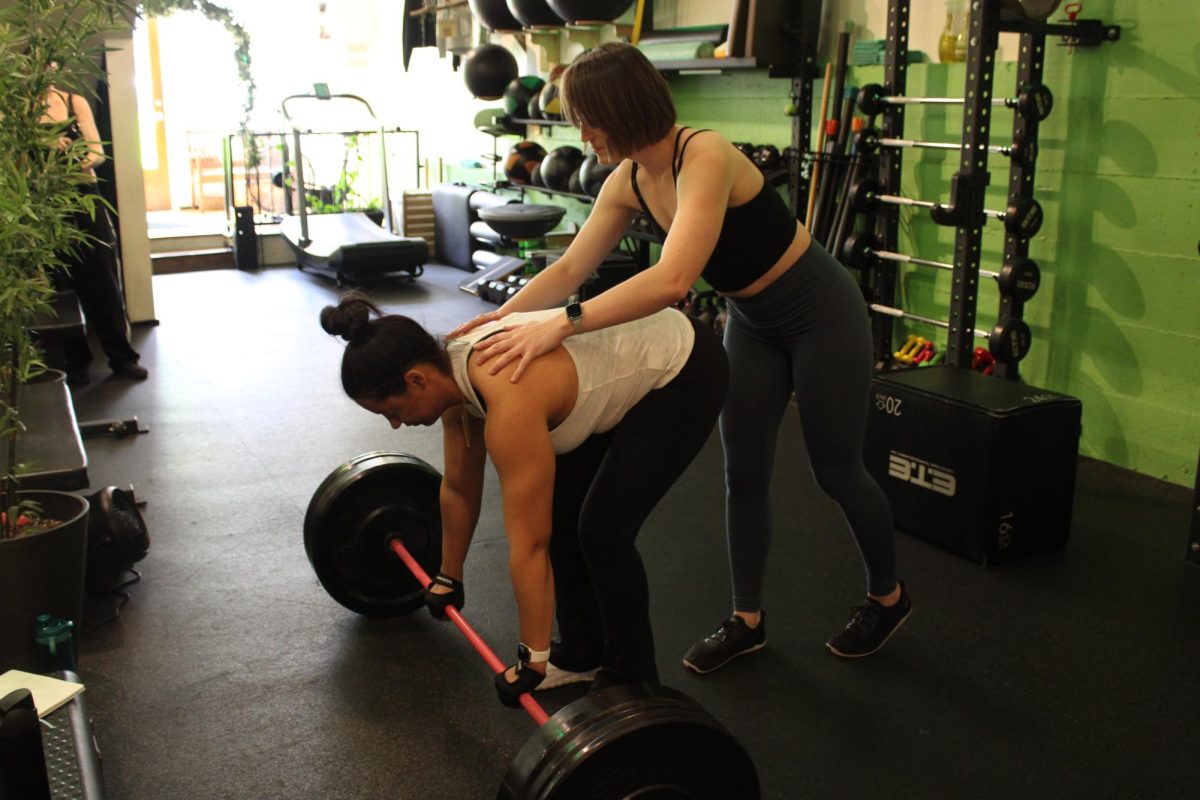
[Bianca Sieraski] So, there’s a lot of equipment here. We have a bunch of dumbbells that go up to 70 pounds. We have medicine balls, yoga balls, barbells…
[Bianca Sieraski] A client and a personal trainer can usually be found at some point in their workout, stretching, doing a bench press, deadlift, squatting, lunging – the possibilities are really endless and trainers cater to their clients personal needs and goals.
[Lara Magdesian] Ever heard of the phrase “use it or lose it?” Tammy’s 67-year-old client Nancy lives by that.
[Nancy] My friends are on their second or third knee replacement, they all have bad backs and they’re very immobile. They can’t move. I would like to postpone as long as I possibly, possibly can.
[Bianca Sieraski] When Nancy was in high school playing sports, there were a lot more barriers to women’s fitness. She felt she had to prove to others that she was just as capable of doing what the men around her were doing.
[Nancy] What I thoroughly enjoy about a woman-run studio and the woman environment is that I don’t have to keep proving things to anyone else.
[Lara Magdesian] Learning about all this and talking to these people really makes me feel inspired to keep going to the gym.
[Bianca Sieraski] I know right. Our health is important, no matter how old we are or what we identify as… Dr. Veri put it nicely
[Maria Veri] Ideally you’d want to see like a more holistic approach to health and fitness. That having, you know, a blend of physical activity and exercise and mobility training is beneficial and that transcends gender. And that’s what we really need to get to. Muscles are okay, no matter who you are.