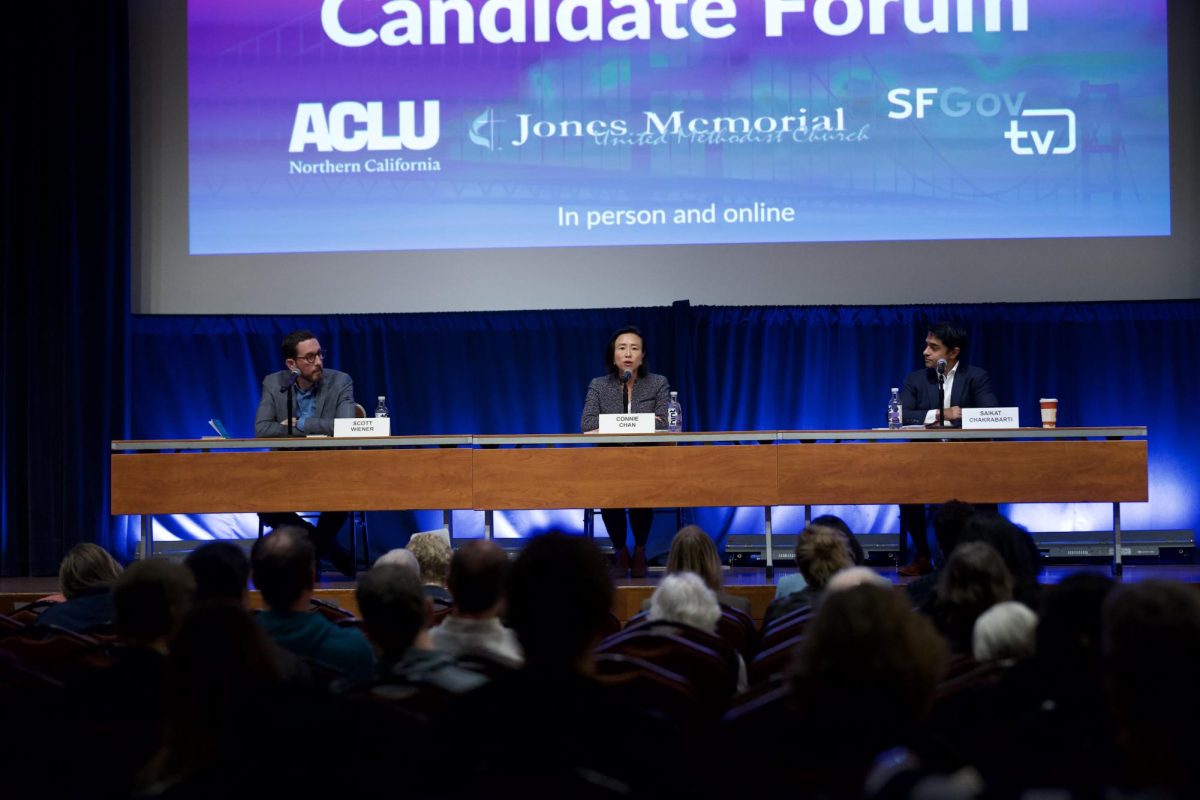
In June, San Francisco residents will vote in a top-two primary election for the 11th Congressional District to decide which two candidates will be on November’s general election ballot to replace former Speaker of The House Nancy Pelosi. After Pelosi announced she would not be seeking reelection after 38 years in office, this election is one of the most competitive for the seat in decades.
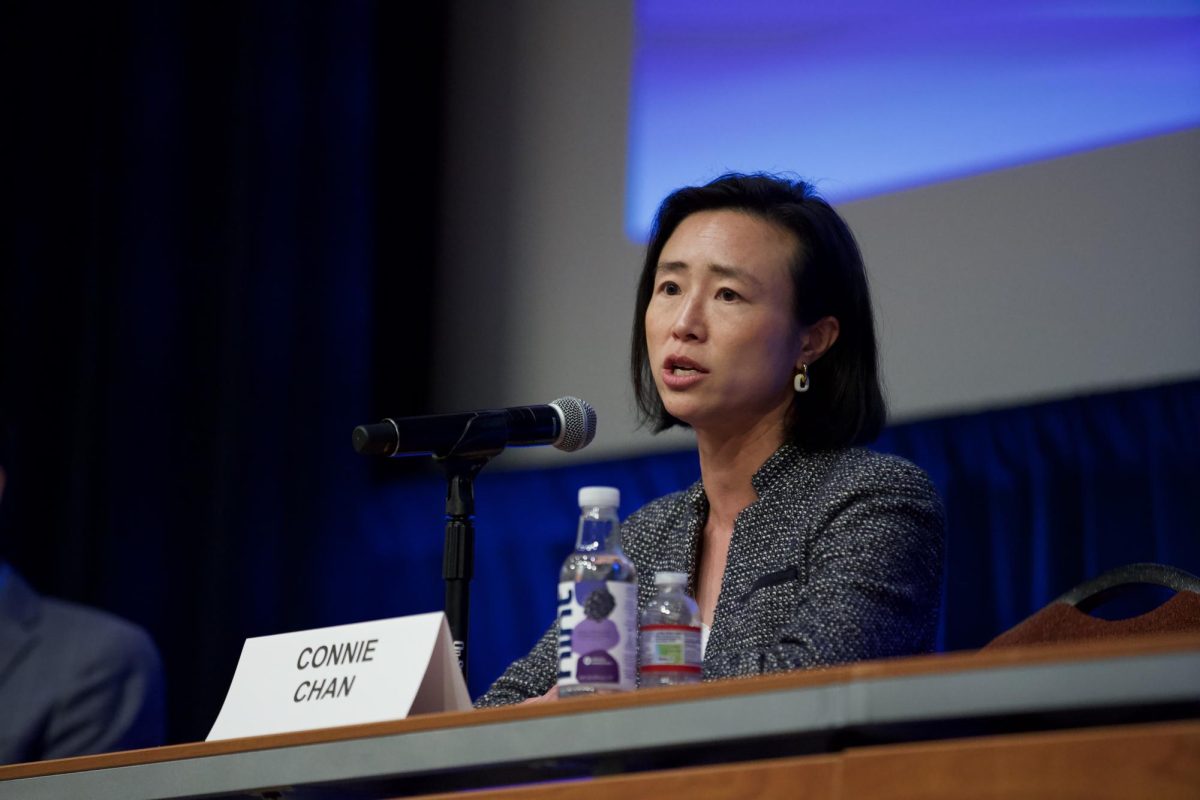
Among the top three candidates to replace Pelosi is District 1 Supervisor Connie Chan. Born in Hong Kong and emigrating to San Francisco when she was 13, Chan’s campaign advocates for the working-class and immigrant communities.
Xpress sat down with Chan to discuss the issues affecting San Francisco residents and students, including a rising cost of living, American foreign policy, potential cuts to BART and Muni and divestment in public education. She also touches on anxiety amid uncertain job markets, the role of AI, immigration rights and LGBTQ+ rights and accessibility, regarding healthcare and education.
The following conversation has been edited and condensed for clarity.
San Francisco is one of the most expensive places to live in the country, particularly for students juggling rent, tuition and possible student debt. What’s your plan to make San Francisco more affordable for students and just for people in general?
We understand that oftentimes, including for students, that the cost of healthcare is burdensome, and it’s been difficult. We want to make sure that there is actually affordable healthcare for everyone. Medicare for All is absolutely something that we will be working on day one.
There’s other things that we have to do at this moment to make life more affordable, and I would say that’s including investment in our education. We want to invest in affordable childcare, fully funded classrooms, as well as free City College. But we also know that there’s also student debt — and we want to provide that relief.
How do we make housing less expensive in San Francisco?
San Francisco’s housing is expensive because it’s part of the, really overall, affordability crisis that I see not just in San Francisco but also throughout California. … The regress of taxation that corporate politicians have imposed on everyday people instead of continuing to pursue a progressive taxation to fund our transit, to fund housing, to fund healthcare, to fund education — we are now allowing billionaires to be able to throw their weights around and influence our politics, our system. We should make sure billionaires pay their fair share.
We should also continue to push for better wages. It’s truly part of the ways that allow people to be able to afford not only living in the San Francisco Bay Area, but in California too. Of course, when it comes down to it, let’s build housing, but let’s also be real: What kind of housing are we building, and who are we building it for? … I’ve been pushing for all the affordable housing bond on a local level so that we can have the money to build the housing. I’m absolutely supportive of the regional housing bond, as well as the state housing bond, so that we can build more housing that people can afford. It’s the reason we’re running for Congress. We want to amend Faircloth, which is the federal regulation that’s been capping rental subsidies. … We want to lift up that cap so that we can increase rental subsidies.
You mentioned pushing to make City College free. Do you also think that four-year universities, like schools in the CSU and UC system, should be free as well?
We see, especially right now, that Donald Trump is spending $1 billion per day in the Iran war and that his Pentagon is coming back, asking for another $200 billion for this war. It’s unacceptable. The U.S. can do better and can actually provide those funding, instead of spending it in a war that no one wants and is illegal. (The War Powers Act allows hostile action initiated by the president to last 60 days till Congress authorizes it as a declaration of war. In Congress, there’s an ongoing debate on the legality of this war; some members argue it’s legal, pointing to the act’s 30-day extension for withdrawal). We can spend that on healthcare and absolutely on education.
And can you imagine what we can do with $1 billion per day in California, we absolutely could actually make state university free.
You mentioned raising wages, but is there another way we could make San Francisco a more attractive city for young people and students entering the workforce to want to work in?
It’s not just about better wages. It’s also about better, more diverse options for jobs. It’s not just San Francisco, but San Francisco is a good example. It works just purely of reliance on tech companies. When COVID hit, all these tech companies can tell their workers that they can simply just stay home and work from home. We see that it really made the local economy collapse.
But thanks to our small businesses, and many other industries, around town, they sustain many of our workforce. When a city like San Francisco, or really any city across the nation, depends on one industry — be it coal mine, and in this case in San Francisco, tech — it’s not healthy for our local economy and/or our workforce. So San Francisco needs to provide diverse options and industries for young people to be able to come. That is why I am supportive of legislation and programming like film rebate. Because we do see that the film industry can be robust and can actually bring diverse workforce here, and they can grow. So there’s so many other investments that San Francisco can make to make it a more welcoming city for young people to come here for all different kinds of jobs. It is our job to make sure that it is a diversified workforce.
There’s a lot of concern among students about AI automating the skills and entry-level jobs that would be available to them leaving college. Do you think lawmakers have a responsibility to regulate AI and make sure that it doesn’t steal jobs for entry-level positions?
Absolutely. I would say that there’s two principles that we must have when we come to regulating AI.
One is making sure that AI, just like any other technology, is safe. We prioritize safety. It is unacceptable, for example, for autonomous vehicles to be completely blocking our streets and blocking our firefighters when there is a blackout in San Francisco. We ought to think about regulating AI according to industry. For example, our health and diagnostic artificial intelligence in the healthcare industry, that we should make sure that it is safe. ChatGPT should be safe for all people to use, but particularly our young people. And so that’s the way that I see regulating AI.
The second principle is to make sure that it does not take away jobs. It should be a backup tool — a technology. A technical tool for workers; to help them, to support them in creating a safer and more efficient work environment for workers. But it’s not here to take work away from workers.
Do you believe that we should reshape our foreign policy toward Israel?
Absolutely. The U.S. should always be an agent for peace. And prioritizing our resources to provide humanitarian aid, not just in Gaza, but everywhere around the world — it’s the reason why I would absolutely push back and reverse the cuts for the U.S. Agency for International Development. That should really be the U.S. government’s priority. And right now specifically for the Israeli government, we ought to hold Israeli government accountable and for them to comply [with] the terms and conditions of the ceasefire, allowing the U.S. to prioritize humanitarian aid from here to Gaza.
We put out a poll before this interview, and the big thing we got back from students at SF State is that there’s a lot of concern over rights being stripped away from LGBTQ+ people. Do you have a plan in Congress to protect the rights of LGBTQ+ people?
Absolutely. And we must start with healthcare. Three things that we ought to prioritize: making sure that we continue to affirm the coverage of Medicaid and to expand that coverage, to ensure that we provide gender-affirming care as well as reproductive care.
Thanks to Speaker of the House Nancy Pelosi, Ryan White Act is a federal grant to provide specifically for HIV and AIDS treatments. And that it has not only not [been] fund fully by the federal government in San Francisco. As budget committee chair, we have made sure that we added to that funding, so that program is fully funded.
When it comes to rights — to be able to have their names on their passport, especially for transgender individuals, making sure that they have rights to safe education environments, learning environments and safe working environments, as well as rights to serve in the military — all these things are things that we’re going to continue to push and stand firm and call out the Trump administration, when they’re violating the rights of our LGBTQ+ community.
How do we continue to prevent a major U.S. Immigration and Customs Enforcement (ICE) takeover of San Francisco, and do you think Democrats are currently doing enough to prevent that?
I would say that the Democrats need to continue to hold firm and not to fund ICE, period.
California is a sanctuary state. We need to make sure that our local enforcement complies with sanctuary policy. In San Francisco alone, since Trump took office, they’ve been violating due process and Fourth Amendment of our immigrant community all around California. And in San Francisco alone, we do have the immigration court at 630 Sansome. And what we have done in San Francisco, as your budget committee chair, not only [do] we make sure that local legal defense funds is fully funded, we also fund, fully, the Rapid Response Network, so that people can actually call to get help.
And you don’t have to be a San Francisco resident. As long as you show up in a courtroom in San Francisco, we have legal defense for you, and we have [a] court observer for you to make sure that we can provide you that support. Clearly, it wasn’t enough because — we already have funded them at $12.5 million per year — we added another $3.5 million at the end of last year when Trump was threatening to send the National Guard to San Francisco. We made sure that we provided additional funding to support the community.
SF State is a commuter school. The majority of our students don’t live on campus, and a lot of them rely on public transportation like BART and Muni. As we’ve seen recently, BART and Muni have been facing a lot of issues. There’s talks of BART even maybe being cut entirely. How do we save our public transportation in San Francisco?
We must fund public transit like we … advocate and invest in public education and public libraries.
I fundamentally believe in progressive taxation and that we should make billionaires and billionaires’ corporations pay their fair share. And while we do have, in this coming November, we have ballot measures like the regional sales tax, it’s regrettable that we are going through a regressive taxation model to fund public transit.
Nonetheless, we need to fund public transit. I wish there was a regional overpaid CEO tax because that’s what we’re doing in San Francisco, in June. … We know that if we have that, BART and all the local public transit can be fully funded.
The CSU system has seen a very unstable budget in recent years. At SF State, we’ve had many programs cut, we’ve had many professors laid off and tuition’s gone up. So a lot of students feel like they’re paying more for less. How do we continue to fund the CSU system and make sure that students are getting the education that they deserve.
I do think that this is both a state and federal investment and responsibility. We also see that it’s not just states, but you see regions — all across, up and down the states — under the threats of Trump lawsuits and taking away dollars for research. The Trump administration is problematic for our higher education, for our future.
We need to invest more in our education, and that is definitely for the state university. That is absolutely a question for our future governor and for our state legislature, that they ought to reprioritize our budget to invest in education.
Do you think your campaign is more appealing to younger and student voters than your opponents?
I think that it all depends on the student. I think students who are immigrants, students who are from working family backgrounds, I think they will understand and resonate with our story but also with our campaign; and also with the people that have endorsed our campaign. We understand the pain and the difficulty and challenges that every working family and working people face every day. … I understand the challenges when you graduate from school: that you’re burdened with loans; and you don’t have great prospects for work; and how do you pay rent? … If that’s you as a student, I think our campaign will be resonating with you. You’re going to recognize what it means when I say this is a working people agenda.