When the U.S. launched air strikes on Iran in conjunction with Israel, killing Iranian leader Ayatollah Ali Khamenei on Feb. 28, 2026, the White House’s X account celebrated these strikes with a meme. They posted a video of Wii Sports clips edited alongside air strike footage with the game’s phrases “slam dunk” and “hole in one.” The caption read “UNDEFEATED.”
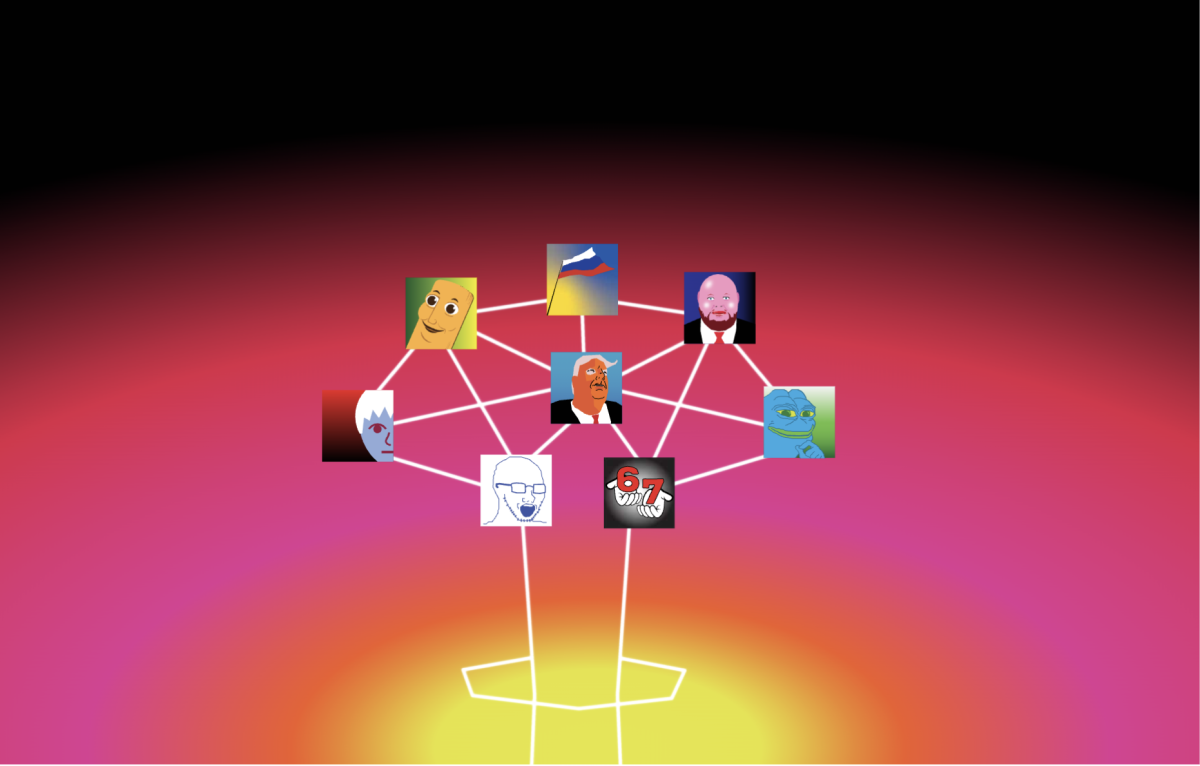
Memes about war and politics aren’t just coming from the White House. Easily spread, they can be seen on any platform, from any person or institution. Often dismissed as harmless, memes in today’s online world can function as a form of political and psychological attack. Known as memetic warfare, this phenomenon is the intersection of how humor, irony and rapid online sharing are increasingly used to spread propaganda and misinformation, shaping perceptions of global events.
“Depending on tone and target, memes can mobilize supporters, ridicule opponents, persuade audiences or manipulate opinion,” stated Tine Munk, digital warfare expert at Nottingham Trent University, in an article she wrote about memetic warfare.
Munk first became interested in the effects of memes on society in 2022 when she noticed a pattern of memes being spread in relation to the Russian invasion of Ukraine. For Munk, she began to see memes as a tool to mobilize supporters and ridicule opponents.
Politicians are utilizing memes as a way to reach a larger audience boosted by online algorithms designed to reward content with visibility and engagement. “They can convene very complex messages into small sound bites, one liners or images that people understand straight away,” said Munk.
California Governor Gavin Newsom utilizes memes to mock President Donald Trump. Newsom’s X account featured a video of the president saying “The golden age of America begins right now,” shortly followed by a record-scratch sound effect and an overlaid clip of a character from the TV show “I Think You Should Leave” saying “You sure about that?”
Some say the government should be utilizing memes as a psychological tool. Jeff Giesea is one of them. Giesea is an entrepreneur who supported the use of memetic warfare in his 2015 article “IT’S TIME TO EMBRACE MEMETIC WARFARE” for NATO Strategic Communications Centre of Excellence: “Memetic warfare today is a fringe concept, but it shouldn’t be. It needs to be developed and brought into mainstream military thinking.”
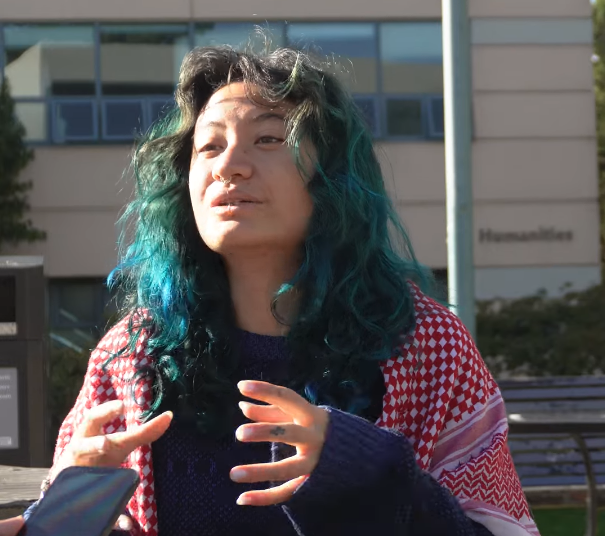
Jalynne Sorrells, a communications student at SF State, said government officials shouldn’t post to social media unless it’s to share policy information.
“People see these memes, and they don’t delve deeper into what the memes are talking about,” said Sorrells. Memes about Epstein Island, for example, caused frustration for Sorrells, who was irritated that no one was really understanding the gravity of the situation.
According to Munk, the lines between media and the realities of war have been blurred. Her research shows that memes have become a part of the informational battlefield. “They shape how you and me, and ordinary people, understand events and how conflicts are interpreted and supported — or the opposite,” said Munk, suggesting that wars aren’t just on the battlefield, they occur online as well.
Memes about tragedy, conflict and politics circulate across the political spectrum, among all age groups. They embed strategic messages that can influence beliefs and distort reality.
According to the Pew Research Center’s 2025 Internet, Broadband Fact Sheet, 96% of U.S. adults say they use the internet, revealing a 15% increase in users 65 and older since 2021.
“It’s about how educated we are, how much training we get in terms of media literacy,” said Munk. “It’s all age groups or all different types of people who are not thinking about what they see [or] about what they’re circulating.” Media literacy is the ability to discern misleading information from factual information spread online.
Renee Hobbs, a media literacy expert and professor of communication studies at the University of Rhode Island Harrington said memes act as propaganda in a similar fashion to Nazi Germany’s use of posters to spread their message.
“If persuasion is effective, it activates strong emotions, simplifies ideas and information, appeals to people’s deepest hopes, fears and dreams and attacks opponents — and it bypasses critical thinking entirely,” warned Hobbs. “When propaganda is good, critical thinking is not a part of the equation, and many of us encounter that every day.”
The fake news crisis in the years leading up to Trump’s election in 2016 is when Hobbs got hooked on researching propaganda’s role in contemporary media — one that she said is rapidly evolving.
“[Trump’s] use of social media is so vastly different than anything we’ve encountered in American history,” said Hobbs. “The volume of his social media output, the raw emotional intensity of it, the way in which he uses it like a stick — the insanity of it is exhausting to people, and they’re tuning out. They’re avoiding the news.”
According to Hobbs, literacy comes from all forms of media — reels, tweets and tiktoks — with memes blurring the lines of distinction. She worries about the implications political leaders’ use of memes will have on civil discourse.
“A lot of these issues reflect current society and our current system that we live in,” said Sorrells. “By making jokes out of it, we’re sort of ignoring how horrible our system actually is.”