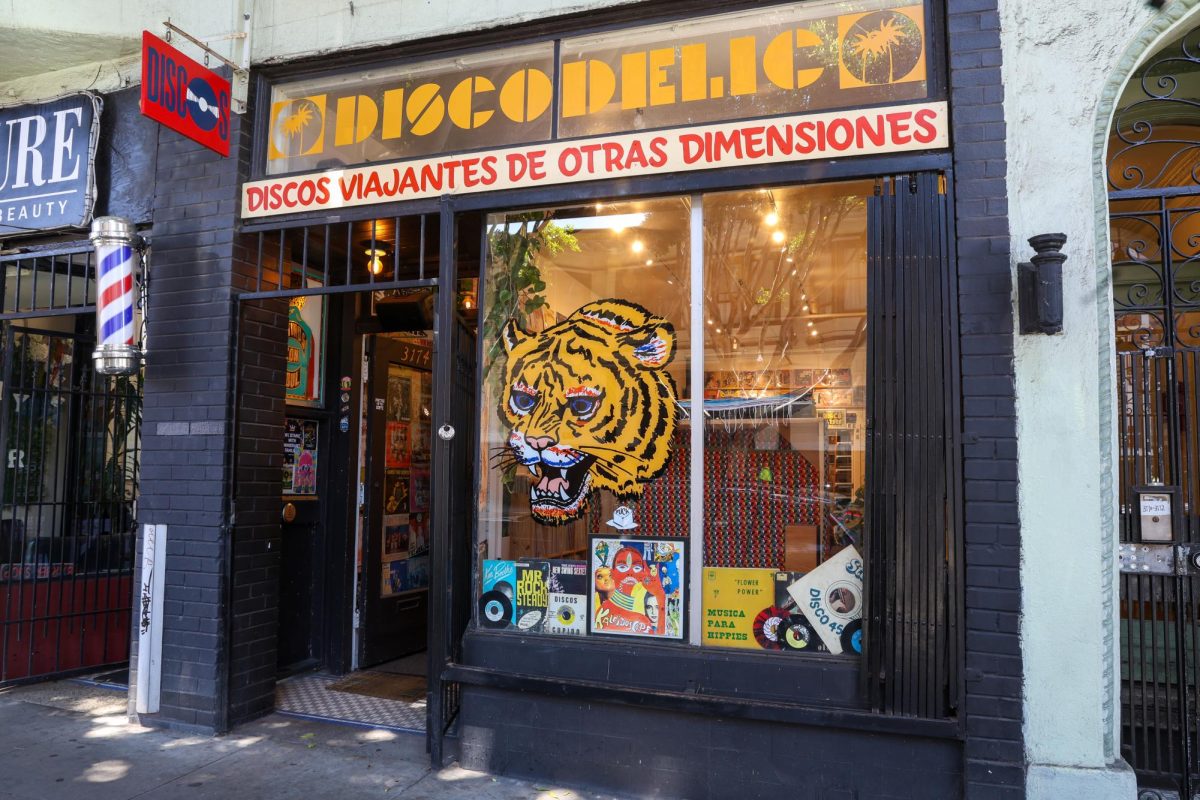
On the stretch of 24th Street between Folsom and South Van Ness, where murals line the walls and Latin music pours out of car speakers, San Francisco’s only Latin record store is reviving a piece of the Mission District’s cultural identity that disappeared from the neighborhood over a decade ago.
Discodelic, which opened in July 2023, specializes in vinyl from Latin America and the Caribbean — genres, like Cumbia, Reggae, Salsa, Latin Rock and Latin Soul, that aren’t a large focus for other record stores in the Bay Area. The store also doubles as a label: It seeks out older records at risk of being forgotten and reissues them for a new audience.
Co-owner Miles Ake explains that Discodelic’s current San Francisco storefront is just one iteration of a project that has traveled several countries.
“My partners, Ruben [Rangel] and Majoo [Salguero] … they had started in El Salvador with the shop over 10 years ago — more as a way to acquire records rather than have a full-blown store. And then they moved it to Guatemala a couple years later, and then from Guatemala to Mexico City,” said Ake. “We were doing a lot of pop-ups around the United States, and then we were like, well, people seem to like it, maybe we should open something.”
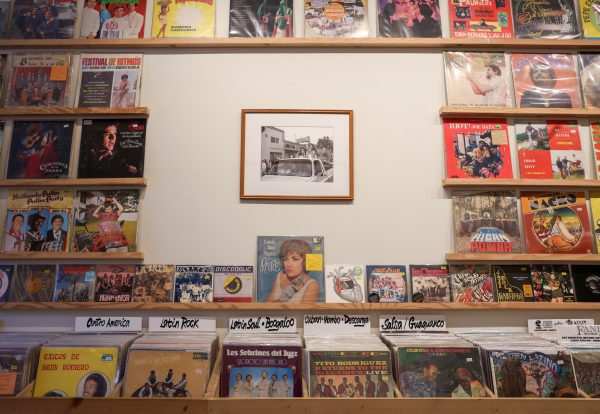
For Ake, who is from San Francisco, 24th Street in the Mission seemed like the perfect place to open a Latin-focused record store.
The stretch of 24th Street that runs from Mission Street to Potrero Avenue serves as the city’s Latino Cultural District and is known as “Calle 24.”
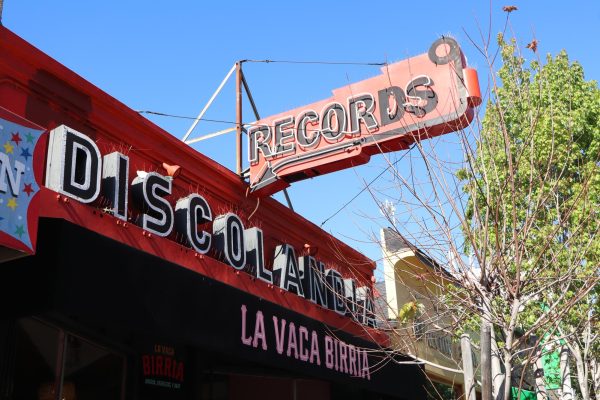
The area once supported several Latin music stores such as Discolandia and Musica Latina. But since both their closures in the early 2010s, the neighborhood was missing something Discodelic hoped to fill.
“It was important to me to bring that back to this area, because it was kind of built on music,” said Ake.
Customer David Dogan, who now lives in New York but visits Discodelic every time he’s in San Francisco, used to shop for records there when the space was occupied by Pyramid Records. He was pleasantly surprised when he saw the empty space was filled by Discodelic.
“One day I just walked by, and it was empty and I was like, ‘Oh, well, that stinks.’ But then the next time I walked by, it was suddenly Discodelic, and I was like, ‘Wow, that’s amazing,’” said Dogan. “I love Latino music, and so I was very happy to see that the one record store on 24th Street was replaced with a different record store — and one that was a little bit more unique for San Francisco.”
Dogan also emphasized Discodelic’s cultural importance for the Mission.
“I think it’s just important to preserve different cultural traditions in San Francisco. It makes a lot of sense for it to be Latino music, especially on 24th Street, which is the Latino cultural hub. So it’s very appropriate, and I think it’s great,” he said. “I think with the massive popularity of people like Karol G and Bad Bunny recently, Latino music has gotten really popular, which I think is great. Places like Discodelic are probably having a little bit of a boom, and people are wanting to go back and listen to those original records that inspired that.”
The Mission was once the stomping grounds for Latin rock artist Carlos Santana and the band Malo. Both helped popularize the genre in the 1960s and ’70s, which influenced Ake’s decision to open it there.
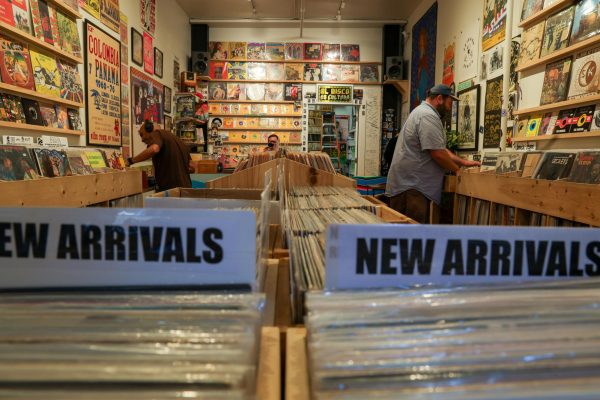
Discodelic’s ties to Musica Latina turned out to be more than symbolic. Last year, Ake received a call from someone in Daly City who wanted to sell their garage full of records which turned out to be the entire backstock of Musica Latina. Ake bought the entire collection of about 20,000 LPs and 50,000 45s.
“We are literally carrying that legacy in a way, because we have all of the music that he [the owner of Musica Latina] used to sell,” said Ake.
Ernesto González, co-founder of Musica Latina, ran the store from 1967 until its closure in 2010. He had preserved the store’s inventory following the store closing.
Mare Perez, a DJ and member of the Chulita Vinyl Club, a vinyl-focused DJ collective that advocates utilizing music and vinyl as a form of resistance against the erasure of culture, finds it important to cultivate community spaces for people of color — especially due to the current presidential administration, which she said places negative attention on them.
“I think being able to create spaces in which we can play our music — not just out loud for the community to hear, but also for folks to come together within that community to dance and feel safe … I think that’s the bigger mission and the bigger picture,” said Perez. “I think being able to have a space that specifically focuses on cultivating and finding Latino music on vinyl, like, that’s super rare. … So I think the fact that Discodelic is out there, and they are creating that space, it’s super important.”
The Mission
Dheyanira Calahorrano, co-founder of IntegrArte SF, a grassroots organization that promotes Latin culture and Spanish language education in the Mission, believes there is a need for community spaces in the neighborhood. Originally from Ecuador, Calahorrano has lived in the Mission for the past 25 years.
Calahorrano started IntegrArte in 2014 after recognizing a lack of physical spaces in the Mission for her son to learn and experience Latin culture and the Spanish language.
According to the San Francisco Planning Department, Spanish-speaking households decreased from 46% in 2000 to 25% in 2023. As house prices grew between 2000-22, the Mission lost around 12,000 Latino residents.
In January, the Mission Cultural Center for Latino Arts closed indefinitely due to financial troubles, which raised ongoing concerns about the disappearance of cultural and community spaces in the Mission. However, the center is currently exploring efforts to reopen.
“Those spaces where — not only Latinos but actually the very diverse community in the Mission District used to get together and enjoy the music, cultural exchange — those spaces are disappearing,” said Calahorrano.
She recognized Discodelic’s importance as not just a record store but a place where the community can congregate and collect itself.
“Discodelic is one of those spaces that are important, not only because it’s reflecting and representing our culture in the Mission District, but because that space just opened up after many other spaces were closing. So it was kind of [a feeling of] hope that somehow something is coming back,” she said.
Calahorrano experienced a moment of cultural exchange herself at Discodelic. While at the store, she met a producer of Afro-Cuban music who was there to promote a new release. She was able to connect him with her son, a drummer who’s interested in Afro-Cuban music.
“My kid is not from Cuba, but he’s a Latino, so it’s a nice way to be learning about the traditions, about the music, the roots,” she said.
Cultural Connection
Juanita Darling, an International Relations professor at SF State with a background in Latin American studies and international media, explained that music is important for preserving cultural tradition.
“It’s the place where those memories are preserved,” said Darling. “For someone who’s in the diaspora and is, in that way, distanced from their roots, it’s a way to connect with those roots and maybe with family that they only see once every couple of years.”
Darling points to intergenerational reach as characteristic of Latin music, making a store like Discodelic particularly resonant. Discodelic can help the children of immigrants better understand their roots, she explained.
“Often when people migrate, they’re just so busy providing for their families that it’s hard for them to take time to pass those traditions on, and this is a place to kind of get filled in,” she said.
Ake explains that the store doubling as a reissue label adds to that accessibility. Ake’s co-owner Rangel, who spearheads the label, often tracks artists down through Facebook or word of mouth in their home countries. After securing the rights to reissue their work, the artists are compensated directly, and their records are reissued for a wider audience.
“A lot of times the records that are reissued are very, very, very difficult to find. And if you find them, they’re usually very expensive,” said Ake. “It makes those rare and hard-to-find records accessible because you could buy them for like $20 instead of paying a grand.”
Vinyl has seen a resurgence in recent decades with sales steadily growing for the last 19 years, hitting one billion dollars in revenue in 2025, according to the Recording Industry Association of America’s end of year report. However, Ake explains the store was never a purely financial venture.
Ake said that the artists are often caught off guard when approached for their records to be reissued.
“A lot of times they’re really surprised that people are interested in this, usually, pretty small portion of their life,” he said. “Maybe they were in a band like in their early 20s that lasted six months, or something, and they put out a record. So a lot of times people are surprised that, first, younger people are still buying records, but also that somebody would be interested in re-presenting that music.”
Just a few blocks away from Discodelic, the Discolandia sign still hangs above its old storefront on 24th Street. Inside the store, customers flip through 45s that once belonged to Musica Latina, looking for something they’ve never heard before. For Ake, that sense of community is what makes Discodelic more than just a business.
“People open record stores for different reasons, some financial, but ours was more for creating a community for people to come to — from out of town and here, too,” said Ake.