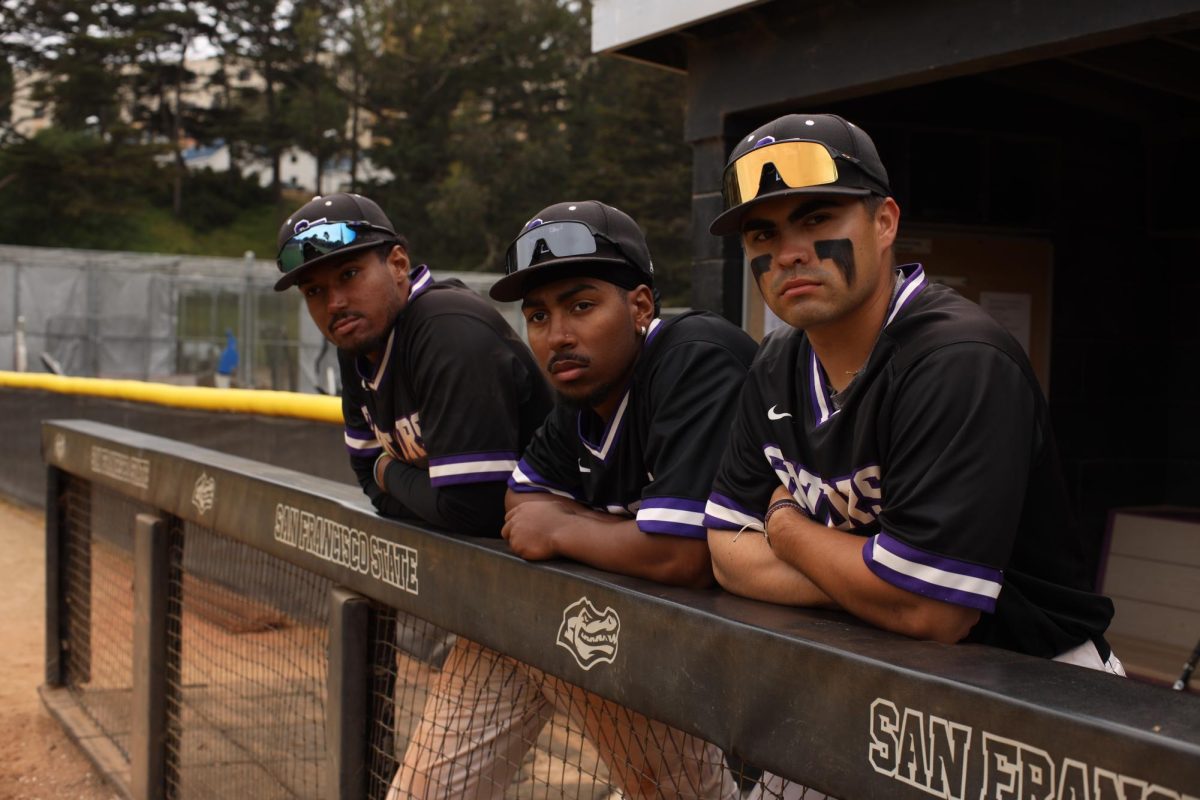
Men’s baseball, women’s indoor track and men’s soccer are completely different sports, but SF State put them in a position to have a common similarity: they have been terminated from the athletics program.
In late summer of 2024, SF State developed an athletic task force consisting of 15 individuals to find recommendations for the 2024-25 operations budget. According to the task force findings and recommendations, the committee included Interim Director of Athletics Brandon Davis and Associate Vice President for Student Life and Dean of Students, Miguel Hernandez, as co-chairs. Men’s basketball coach, Vince Inglima, and women’s basketball coach, Natasha Smith, were the only coaches.
According to Davis, the main concern was addressing the $1.2 million debt accumulated from over-dispersing scholarships. The teams that were the most expensive and unable to reduce the costs in a manageable way were cut.
Men’s Baseball
By Sarah Louie
The impact of the decision was unique for each team. For SF State’s men’s baseball, the team was in the midst of starting their spring season when they received the news.
Interim Director of Athletics Brandon Davis and Vice President of Student Affairs Jamillah Moore gathered the baseball athletes in their dugout at Maloney Field and delivered the news.
“She [Moore] sat in the corner, and she just talked to us and said, you know, ‘We’re deeply sorry,’” sophomore Brandon Gaston said. “We got to ask questions. It basically just felt like, whatever, like a ‘fuck you.’ ‘We’re so sorry that we’re cutting you,’ but then they wouldn’t give us a valid reason why.”
Since Gaston walked on last year, his focus remains on finishing this season and building stats to enter the transfer portal with. He has two years of eligibility remaining.
The men’s baseball team has received a lot of support, not from the university, but from their head coach, Tony Schifano, who has been with SF State for 10 seasons now.
“A university is a business at the end of the day, and I understand that,” Coach Schifano said. “You have to hit your numbers and what-not. But, there could’ve been more of a warning in the previous year or two about, ‘Okay, let’s try to work within a budget’ — and that’s every team.”
For seniors with no eligibility left, like Justin Johnson and Nathan Shinn, they look forward to pursuing professional baseball and offering advice to younger players on the team entering the portal.
“It’s in everybody’s head, but then at the end of the day, we still want to win,” Watson said. “I guess our goal is to show them up. We still have something to prove. They have a good season, you know, stats look good. That’s how you get offers somewhere else.”

Women’s Track and Field
By Luke Cramer
SF State president Lynn Mahoney stated in a letter published March 6th that only the indoor season of women’s track and field is being lost. Yet, according to Davis, the cuts are more expansive.
All non-distance events will be cut regardless of whether it’s indoor or outdoor season. There are 23 track and field events listed by the NCAA, (National Collegiate Athletic Association) but only five are defined as distance events.
Mina Tsai, a kinesiology major, is graduating this semester. She transferred to SF State and competed last year in sprints and jumps.
“They’re just trying to say ‘Oh, it’s not that big of a deal because we’re just cutting women’s indoor track and field,’” Tsai said. “No, they’re cutting outdoors too because track and field consists of sprinters, jumpers, throwers, it’s not just long distance. We’re the main ones that are consistent of track and field, and that’s what they’re cutting.”
Although there are still cross-country runners at SF State next semester who could compete in track and field, there may not be enough of them. The NCAA requires that each Division II track and field team has a minimum of 14 students to compete in scored meets.
The announcement came during the season, forcing students to stay another semester instead of transferring to a place where they could compete.
Though traveling during the indoor season is more expensive, the outdoor season is much cheaper, according to Atanas Atanassov, the Interim Head Coach. The same nice weather that made indoor facilities in California redundant and sparse also made outdoor meets easily available. Antanassov believes mismanagement by the administration is the cause of cuts, and that there’s a way to spend the money more efficiently.
The cut of all this traveling was unable to save Atanassov’s job. Coach Atanassov had only worked for the school since mid-October, making it the shortest job he’s ever had.

Men’s Soccer
By Bailey Zitko
As news broke that the men’s soccer program will head toward vacancy, players were left to navigate their future nearly four months after their season ended and the recruitment process had already begun.
“The timing was so late, so it would’ve been nice if we got the next semester so that we all can prepare ourselves,” said Maximilian Drexler, a midfielder on the team.
The struggle to find a school to transfer to isn’t one the soccer team is facing alone. Sonoma State University and Academy of Art University’s sports programs were also recently cut, creating a crowded transfer portal.
Sebastian Carrasco, head coach for the men’s soccer team, describes how the new rule from the NCAA for Division One men’s soccer — reducing the maximum number of team players from 35 to 28 — has been an additional factor in overwhelming the transfer portal.
“You have 500 players in the transfer portal like normally we have,” Carrasco said. “Now we have like 1000 players.”
Amidst the athletes across the Bay Area looking to relocate, over half of the SF State soccer team has succeeded in finding transfer options. While Carrasco confirms that a fortunate 70-80% of his players have found programs, the remaining 20% have one thing in common — their student visas.
For Drexler, an international student from Germany, with only one year left of eligibility knows he’s not as desirable to higher-ranked schools.
From his perspective, getting a degree from a reputable school like SF State holds a heavier value internationally than playing at a lower-ranked school.
Although for Drexler, cutting his soccer career short and staying at SF State to finish his degree may not be what he anticipated, it is something he has to consider for his future.
After hearing Carrasco’s contract was renewed, players considered themselves safe from the budget cuts.
Their relief was short lived. Players soon found out through their peers that men’s soccer would likely be included in the elimination.
“Mentally, it’s all killed us a little bit,” Drexler said.

The last dash
For all players, it seems this decision carried weight on them mentally. None of them were prepared for this to be their last season nor did they imagine that this season’s stats would also be the last for the program. And for some, an unexpected goodbye to the game they have played their whole life.
According to players, outside of an email — sent to the entire student body announcing the cut of the three teams — President Lynn Mahoney has yet to personally speak to or address the three teams affected.
And now potential termination of the entire athletic program is a reality, and this time it isn’t up to the task force, instead it’s up to the student body to vote on.
According to Davis, that $68 fee has not been touched in 15 years. If not enough students vote yes to that $32 increase, then the entire athletic department staff will be in a similar position as the players were put in months prior.