

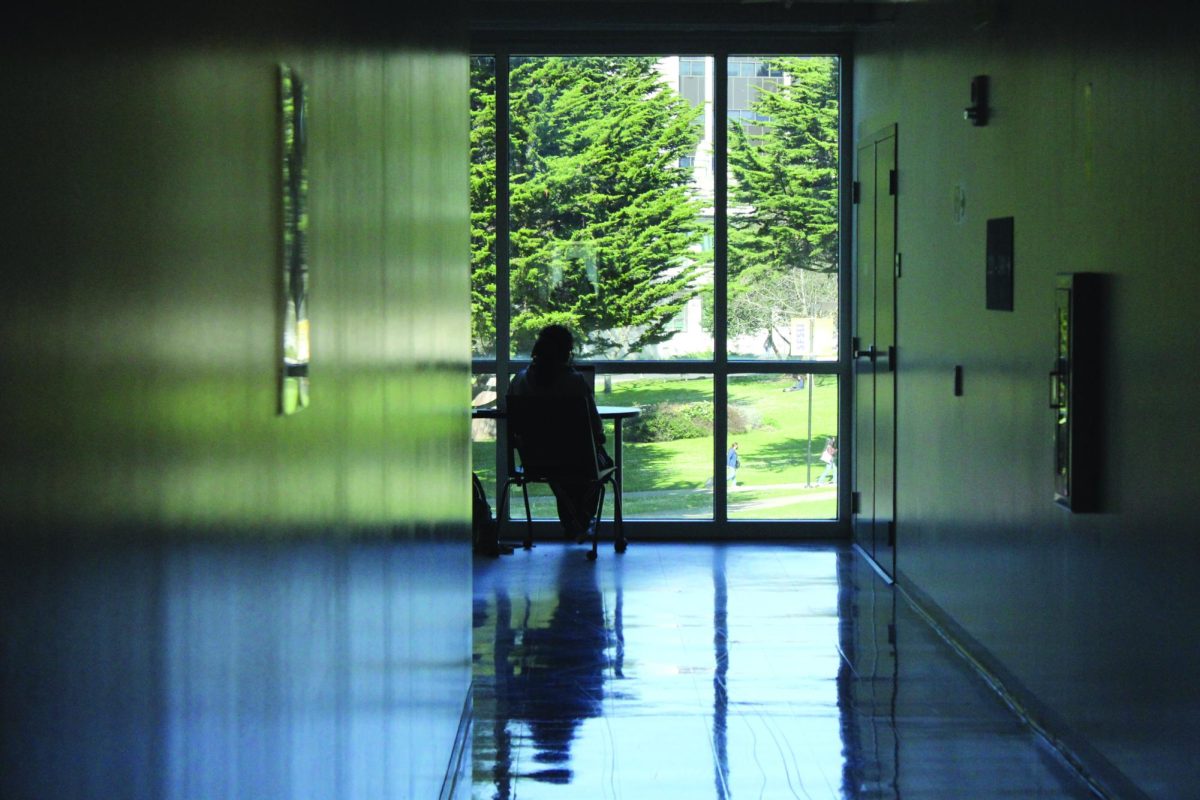
Sitting in an advisor’s office, looking over your degree progress report — it’s hard to ignore the perpetual anxiety of uncertainty. A missing credit or taking the wrong classes can set a student back an entire semester. The expectation of a college advisor suggests them to be helpful and informative, yet for many students at SF State, different words may come to mind.
A combination of advisors failing to point out issues with degree progress and unresponsiveness points to a trend of unsatisfied students at SF State. Concurrently, according to SF State’s 2020 data, from their Institutional Research and Student Right-To-Know on graduation rates, SF State is seeing higher rates for students to graduate in six years as opposed to four.
“With better guidance, I could have saved myself a lot of money,” said Andrew Roberts, an SF State alumn who graduated in 2025. Although he transferred to SF State with units from his other school, it still took him an extra semester to graduate than he originally had planned. “I couldn’t get a response when I needed a response, which was really important because of the time-sensitive nature of the classes.”
According to SF State’s Student Right-To-Know, a campus security act requiring institutions to disclose certain information, the graduation rate within a six-year time frame is 55% — despite a bachelor’s degree typically taking only four years to complete. While this doesn’t specifically correlate with advising issues, experiences like Roberts’ are an example of how they can play a part in this extended time frame.
The Advising Model
The Associate Dean of Undergraduate Education, Kimberely Altura, oversees the Undergraduate Advising Center (UAC), the main location where academic assistance is offered. Students in their first and second years frequent the center most often and rely on the undergraduate advisors, while students with upper-division requirements are typically referred to faculty advisors.
According to Altura, in Fall 2022, SF State implemented a new undergraduate advising model that provides students an academic advisor for two years before switching them to their college advising team. Altura said they found less issues with misadvising after this model’s implementation, based on about 1,300 of their student surveys in 2025.
“I know there are cases of misadvising that happen or misunderstandings that happen, but I actually have seen the number of those go way down over the years,” Altura said. “If there are concerns, we want to know about the concerns.”
Additionally, a “whole-degree advising” plan was set in place, which allows undergraduate advisors to assist with both a student’s GE and specific major and minor requirements.
Before the new model, students had their own faculty advisor and a college-based resource center they could go to, which was difficult to navigate for students. “Sometimes students didn’t know where they needed to go,” said Altura.
Advising and Accountability
Marissa Martinez, a third-year business marketing major, said when she was a freshman going to undergraduate advising, the help she got felt impersonal and not specifically catered toward her needs. “Everyone’s experience in college is going to be different, so stop saying what you’re telling every other student,” said Martinez.
After entering SF State as an undeclared major, she found it difficult to navigate the resources provided for her. It was only when she became a residential assistant that she became more familiar with the resources around her and who she could speak to for guidance.
Martinez felt that faculty advising was more specific towards her concerns. “They know what I want, and they’re able to connect with me, which means that they’re able to find the right classes that fit for me . . . and that would be the most beneficial for me in my future.”
Similarly goes for Roberts who said that his advisors were partially to blame for how long it took him to graduate, although he recognizes that he had not made up his mind on a specific goal.
Roberts said along with the absence of response, the lack of understanding when acknowledging students’ difficulties needs to be better regulated by advisors. He would like SF State to be more interested in the outcomes of their students’ post-graduation; if a student isn’t on track, that should be addressed.
“I’d like to see something from the advising department that takes accountability for each student,” he said about SF State.
Besides accountability, Seneka Varos, a third-year business finance major, wishes the undergraduate advisors took more time to be empathetic towards students.
“Knowing that they have so many students to get through, I think they’re just, like, always pushing to get the next student in,” said Varos. After visiting the center a couple times, Varos lost interest as she felt they weren’t providing any help that wasn’t already accessible on the student center or gateway.
There are also those students who don’t utilize the advising resources as much as others. Nate Mugambi, a computer science major, says he rarely meets with advisors himself, although he acknowledges the difficulties other students might have. “I feel like a lot of college students … say ‘Oh, the counselors and the advisors don’t help us in anything or this and that,” said Mugambi. “But I’ve actually never ran into that problem.”
Behind the Scenes
Faculty advisors not only have to teach their students and contribute to disciplinary research, but also need to be available for students to provide them guidance.
Omar Sosa-Tzec, a professor and faculty advisor of the design department, started teaching at SF State in 2020. At his previous position at Indiana University and University of Michigan, Sosa-Tzec said they had separate faculty who specifically advised students, rather than professors taking the work for both.
After his transfer, Sosa-Tzec explained there was no official training provided on how to advise, but their department chair and faculty meetings helped bridge that gap. If there was any disconnect, it was more so due to the struggle of collaborating efficiently with the UAC.
“I think in the UAC, they tell them [students] — and this is my perception that might be wrong — ‘just take classes and graduate,’” said Sosa-Tzec. “When in reality that might not work for the program.”
Sosa-Tzec noted that due to budget cuts, there hasn’t been much help for the faculty advisors, making it difficult to balance the workload between planning, teaching and advising students.
These issues also critically affect transfer students, who Sosa-Tzec said often come in without prior knowledge of what classes they should have taken for their major’s roadmap. From what he can discern, during the summer, typically only the head of the department is available for help.
The resolution? For the design department, the faculty is working to develop a one-unit class where students must meet with a design faculty advisor within their first years to better understand what classes they should take and when.
“Since I’m part of a team that has a single objective,” said Sosa-Tzec. “That’s something that the UAC doesn’t have.” While the UAC has some idea of students’ major roadmaps, he said that faculty advisors have more insight on what a student needs to graduate from their respective department. “That’s the benefit of teaching; because you’re involved in the backstage.”
“We faculty, who are shaping the classes, arranging the classes, defining the syllabi, defining what we want [students] to do, … we have that vision,” said Sosa-Tzec. “So when you give advising, you know that the vision is in the back of your mind.”









AD • Mar 18, 2026 at 9:10 pm
Lmao what? How did this make it through editorial review?
As a transfer student alum (class of 2024), it’s embarrassing to see the Journalism department put this out. An undeclared major had “more specific” support after declaring a major… obviously! A transfer student graduated with only ONE extra semester after being unsure of their goals AFTER transferring, and that’s framed as an advising failure? If you’re still not sure about your goals after transferring as a junior, that’s on you.
I don’t even know where to start with the professor who is so egotistical he decided to shit on his colleagues based off a “perception that might be wrong”.
To quote Roberts, I’d like to see something from Xpress Magazine that takes accountability for this article lol