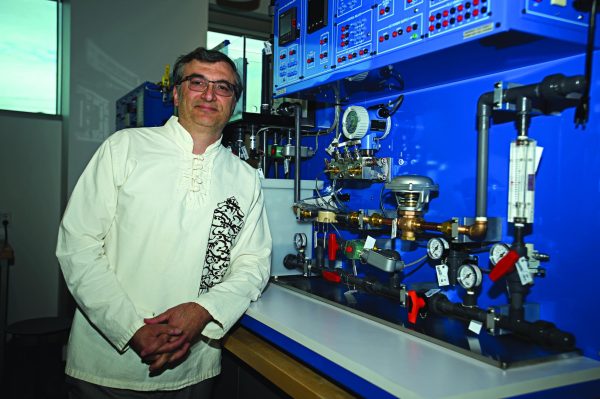
In a fluorescent-lit classroom, where whiteboards are usually filled with mathematical equations and diagrams, Professor Mojtaba Azadi’s early-semester ritual changes that typical writing on the wall.
Instead of diving straight into formulas, Azadi, who teaches mechanical engineering at SF State, asks his students to read the first chapter of their textbook on the history of control systems. Then, he has them trace their ancestry.
Dry-erase markers glide across whiteboards as students map out their lineages. Names, places and dates fill the space. Then, Azadi returns to the textbook, asking students: do any of the book’s stories sound familiar? Are any of those stories part of your family history?
A few hands go up — sure, students recognize some of the names in the text. Then comes the realization.
“‘Oh, this narration — this is a Eurocentric narration that we get in our books.’”
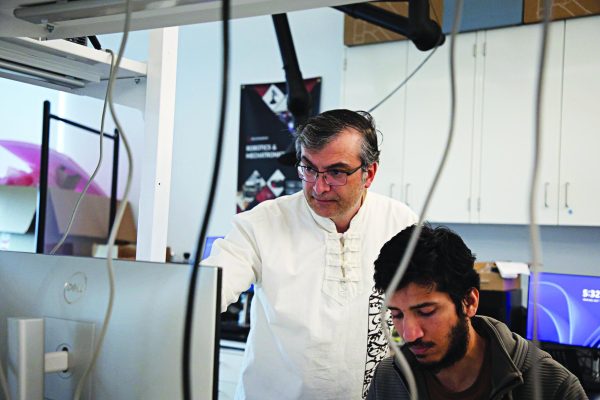
For Azadi, that’s the point. In a more typical STEM curriculum, aiming for optimization and a singular solution, often without context and consequence, outweighs more holistic ways of thinking. But for Azadi, interrupting that tradition by using a humanistic approach matters more than simply measuring a mechanical property.
“When you find a solution, you can send a man on the moon,” explained Azadi. “But at the same time, we can also send a rocket to kill millions of people.”
At a time when universities increasingly measure success by workforce readiness, the value of what was never meant to be quantified — the humanities — is being called into question. Historically, that wasn’t the case. When universities arose in the 13th century in Europe, students were required to study the classical liberal arts before specializing in a discipline.
But at SF State — an institution that inherited the liberal arts in 1935 and has been rooted in them ever since — that tradition is shifting. As the California State University (CSU) system grapples with a projected $2.3 billion deficit, priorities are pivoting toward cost efficiency and workforce preparation. At the same time, humanities departments struggle to address the cost-saving demands of an emerging CSU education model — one that favors vocational outcomes over intellectual inquiry and expansive learning.
The humanities were once central to the promise of higher education. “That was always baked into the idea of a university,” said Jennifer Frey, a philosophy professor at The University of Tulsa. “It was only until very recently — I would say the last 100 years or so — that universities started to back away from that.”
Over time, Frey explained, universities have rebranded the liberal arts — not as foundation for cultivating free-thinking individuals, but as a means of building skills for the workforce.
Through layoffs and program discontinuances, students and faculty from the humanities have a front-row seat to their programs’ growing expendability. This vulnerability is on full display, and its effects are beginning to ripple across campus, even reaching students who have never set foot into a Humanities classroom.
In 2024, a vote by the CSU’s board of trustees whittled down the general education requirements for the 2025–26 academic year. Now, SF State and other CSU universities follow the same general education patterns of California General Education Transfer Curriculum. This change to the Title 5 of the California Code of Regulations cut the humanities requirements nearly in half. It eliminated Area E — lifelong learning and self-development — as well as arts and humanities course requirements for incoming community college students and first-time freshmen at California’s public universities.
“Part of the idea of any education is to have a cluster of things that people are expected to know for competency in the major and then another series of things that you get to explore through electives,” explained Will Clark, an English language and literature professor at SF State. “With those being attenuated, there’s less opportunity for that exploration for students.”
When students aren’t exposed to a liberal arts education, Frey said they risk skipping a formative step necessary to flourish. For Frey, “successful” isn’t defined by job titles and salaries, but by the ability to live a thoughtful, curious and meaningful life.
The Promised Land
At a campus defined by its diversity, SF State has offered generations of students access to a liberal arts education, after evolving from a teacher-training school. Contrary to the elite standing often associated with liberal arts, the curriculum has long remained within reach for SF State students.
“This is why I love SF State, because it’s kind of the best of both worlds,” said Political Science Professor James Martel. “It has the questioning traditions of the humanities, but it’s also a working-class university and has always been a truly leftist place without all that privilege. So to me, it’s like the promised land.”
Today, that “promised land” is shifting under our feet.
SF State is projected to face a $7 million shortfall, according to the university’s 2025 Convocation Remarks, and is also facing a 7.4% decline in enrollment from 2024-2025.
This spring, seven departments — Anthropology, German, Italian, French, Classics, Humanities and Comparative World Literature, and online Ethnic Studies majors — were suspended or discontinued. A year prior, the master’s in women and gender studies, the master’s in anthropology and the bachelor’s in Chinese (specifically, the Concentration in Flagship Chinese Language) were suspended.
Beyond the CSU, Nancy Gerber, a biochemistry professor and the IRC’s elected chair, described the entire academic culture as slow to change, noting that the best way to deliver an education may look different than it did 40 years ago.
“I’d like to look at this — even as painful as it is — as a glass-half-full situation, where there are some opportunities for us to really reimagine what our degrees ought to look like,” said Gerber.
The Beginning of the End
Martel’s first inkling of the gradual deflation of humanities came in the late 2010s. As chair of the political science department, a new scale of assessment had been introduced for faculty to gauge student learning outcomes. Martel remembers his initial word-based evaluations were dismissed; instead, a group constituted by faculty with aspirations to join the administration asked him to provide numerical measures — what he considered ineffective metrics for evaluating subjective means.
“I was like, throw that in the garbage. Just give them numbers,” Martel told the sociology chair at the time.
Nearly a decade later, SF State has ended 615 lecturer faculty contracts across departments, and this spring, 21 out of the 102 College of Liberal and Creative Arts (LCA) faculty members applied for buyouts.
To combat fewer class offerings, administrators are building a consortium across CSU campuses. Provost and Vice President of Academic Affairs Amy Sueyoshi explained this as giving students more choice in their class selection, even if it means taking a class online and from another campus.
“Ideally, we don’t want to cut classes,” explained Sueyoshi. “We want to create a schedule that matches the number of students on our campus. So that means we may not offer as many electives on our campus if we have fewer students. … You can take your electives someplace else, on a different campus.”
When Exploration Became Vocation
While the origins of liberal arts trace back to ancient Greece, Clark points to the 1950s, when the GI Bill expanded access to higher education. Though technically race-neutral, the policy was notably gendered and, in practice, racially exclusionary — benefitting almost exclusively white men. Still, by paying veterans to attend college, the GI Bill opened higher education to the non-elite and encouraged intellectual exploration, where learning and knowledge were not yet narrowly tied to career outcomes or earning potential.
A pronounced turning point for universities becoming what SF State Professor David Peña-Guzmán calls “vocational training,” came in the 1970s, when states began divesting from public education as a common good. As costs were transferred to students, the focus shifted from civic value to economic return — students needed to prioritize paying off education debt rather than cultivating knowledge.
At SF State, economic pressure is heightened by the student population itself: 58% of undergraduates receive financial aid, and 32% are first-generation college students. Peña-Guzmán, who teaches comparative world literature, said these students often engage in a different kind of calculus — one shaped by familial pressure for upward mobility and landing a job immediately after graduation.
Natalie Hendrix applied to a licensing program in Clinical Laboratory Sciences (CLS) at SF State in March. However, she’s a San Jose State microbiology alum who initially wanted to study animation. “I was told by my family that they wouldn’t support me … if I did [animation] because, essentially, I was digging myself into a hole in their eyes.”
Hendrix doesn’t regret her decision to pivot, but she has seen a lot of people pursue majors like computer science purely because of its perceived profitability.
A 2024 study by the Federal Reserve Bank of New York found that liberal arts, journalism and ethnic studies majors had a lower unemployment rate than mathematics, computer engineering and physics majors.
When Audrey Macivacar transferred to SF State from community college this spring, her pursuits in anthropology were intact despite judgment from her peers. But a month into Macivacar’s first semester, her degree roadmap was fissured, amplifying the pressure.
In February, Macivacar received what she described as a vague email informing her that the anthropology program was being suspended.
“I’m debating if I should even stay at SFSU because they don’t have what I need anymore,” said Macivacar.
The Toll of an Antiquated Narrative
The humanities are rarely sold as job training, yet they’re often criticized for job market incompatibility.
Clark remembers this narrative as a UCLA graduate student. Seats were filled — so much so that the English department’s high enrollment enabled other departments with fewer students to get by.
“But the chancellor had this narrative about what you do with it. The English major is fragile. It had no correlation to the actual information,” said Clark. “Here [SF State], it’s easy for the dean or the chancellor to say, hey, we’re not seeing enrollment in the LCA departments. But like with UCLA, you were seeing it, and they were still promoting that narrative.”
Martel argues that humanities are much more efficient from a market perspective and teach valuable skills that transcend from job to job.
“I definitely think there’s a huge campaign to get people … to major in STEM and proof’s in the pudding,” said Martel. “The humanities enrollment has collapsed. That’s why LCA has been hit so much harder than the other colleges.”
The difference for Sueyoshi is that two ends of one thread are being pulled: Challenges at the administrative level have to address the balance between giving a faculty line to a major that has 1,500 students or one with 60 students. In other words, when departments are competing for funds, those with more students win.
Still, Sueyoshi said, “There’s a number of studies that say that when you come out with a humanities degree versus a STEM degree, the STEM person might be making more money out the gate. But in 10 years, 15 years, the humanities person will actually be the manager of the STEM person. The reason why is because they’re better at communicating; they’re better at interacting with people.”
Exposure
Hendrix, with her microbiology degree, sees the importance that humanities play in ethical and moral decision-making. For her, those practices can be lost in science-related careers.
Following Apple’s launch of the iPad in 2010, Steve Jobs said something similar: “Technology alone is not enough. It’s technology married with the liberal arts, married with the humanities, that yields the results that makes our hearts sing.”
As Hendrix applies to SF State, she’s attracted to clinical lab science’s emphasis on people in diagnosing patients, an element she often found left out in her prior STEM classes.
The Tulsa University Honors College, which Frey formerly oversaw as dean, offered an alternative general education program centered on collective deliberation about the future rather than immediate career preparation.
The largest major among freshmen in the college — nearly 30% — was engineering. Many of these students, according to Frey, later added a double major or a minor within the humanities by the end of the program.
Humanities, explained Frey, are “incredibly important,” adding that if we give them up, we give up on the idea of the university. “It’s existential for the university, but it’s also existential for the student.”