

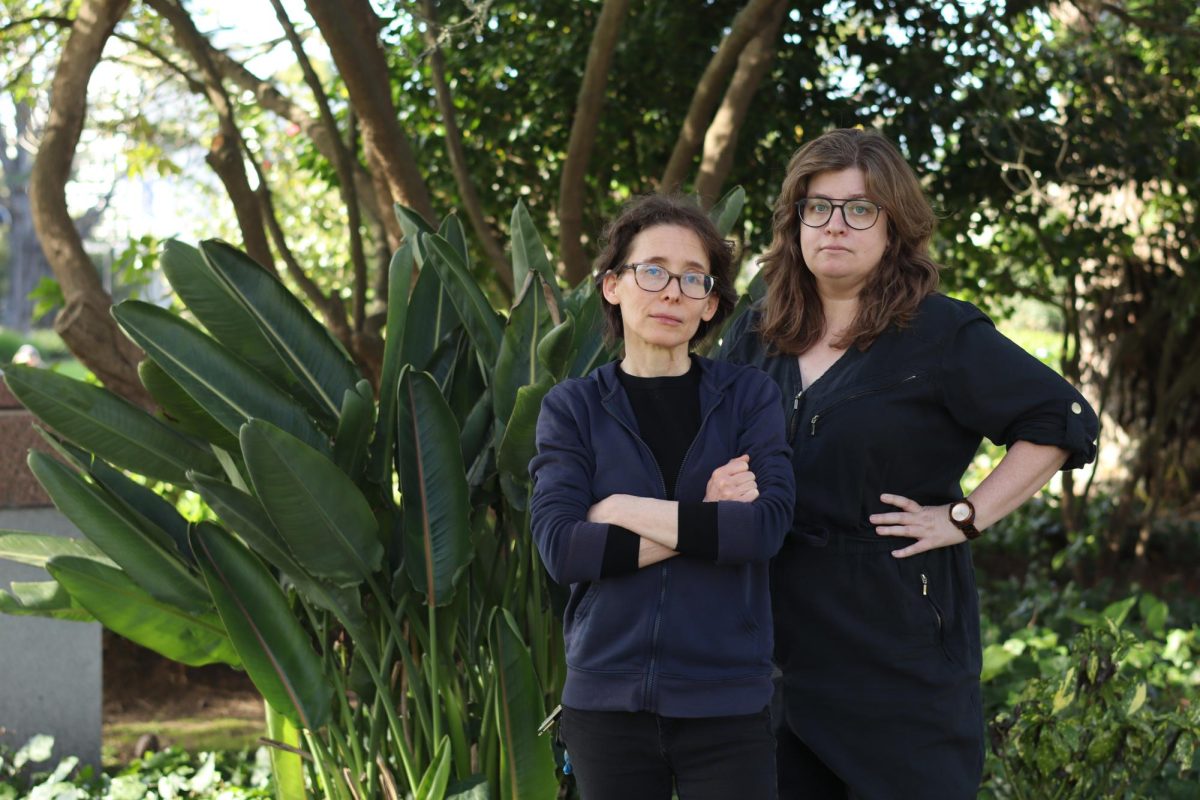
Martha Kenney and Martha Lincoln were already critical of AI’s negative effects on higher education when the CSU cut the metaphorical red satin ribbon and entered into its OpenAI contract. Nearly a year later, Kenney and Lincoln are petitioning against renewing the contract, arguing that the agreement reshapes the university’s identity.
“We have made this argument — that the CSU is the guinea pigs, or the canary in the coal mine in AI and high education,” Kenney said. Now, they’ve co-authored “Cancel ChatGPT Edu. Invest in Humans,” a CSU-wide petition — a call to arms for students, faculty and California residents — challenging the contract’s renewal, asking Chancellor Mildred García to redirect funds toward a human-centered CSU workforce.
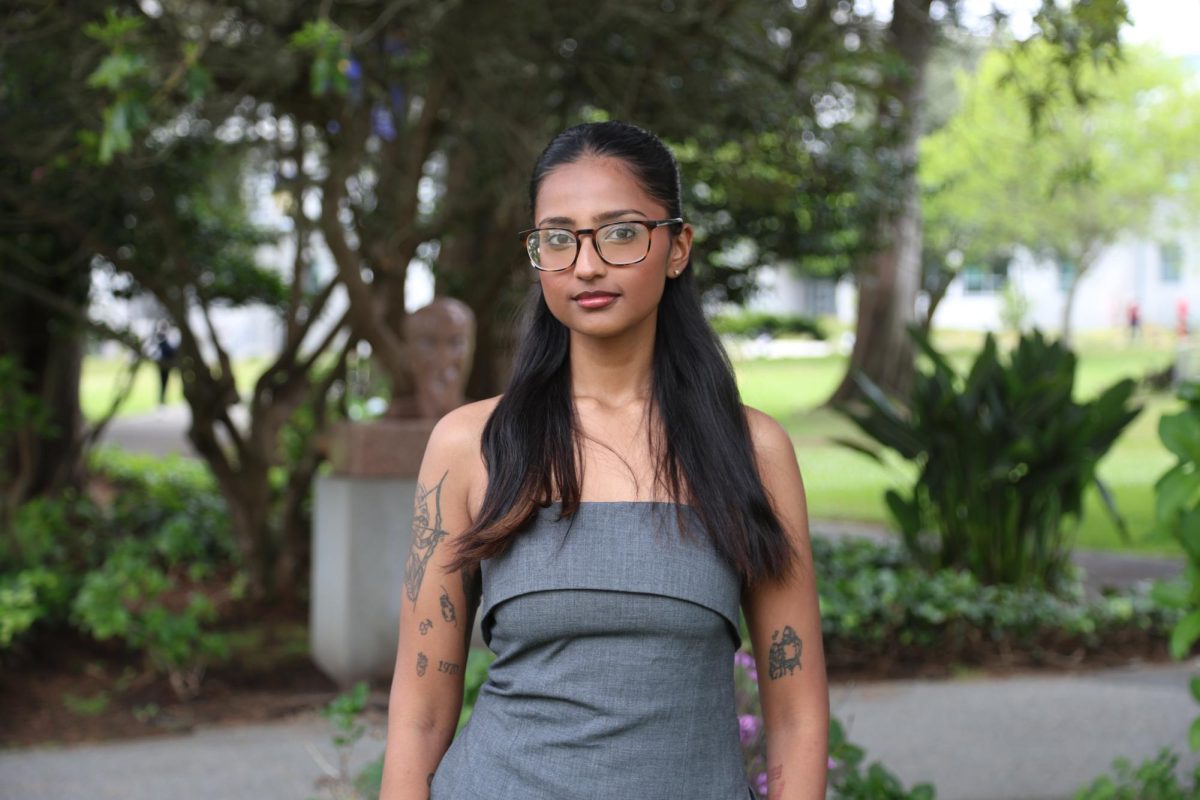
Kenney and Lincoln, who researched AI and social justice through SF State’s Healthy Equity Institute, spoke to Xpress about how the petition came to be and where they see AI headed in higher education.
The following conversation has been edited and condensed for clarity.
AI can often feel like navigating this two-way street of right versus wrong, yet there tends to be a lot of gray area with it. How did this petition come to be?

Kenney: Martha Lincoln and I were involved in the leadership of the Science, Technology and Society (STS) Hub last year, and we had a thematic year on AI and social justice. We were paying close attention to the issue of AI in higher education. But in February 2025 — just like everybody else on campus — we learned that the CSU had struck a deal with OpenAI to provide ChatGPT Edu to all 23 of its campuses, and now 22.
This was really shocking to us. We hadn’t heard that the CSU was in talks at all with OpenAI and, because of our work with the STS Hub, we were really critical of the potential for generative AI technology to negatively affect the conditions of labor for professors, the conditions of teaching and learning for students and other things like discrimination and equity issues.
The petition came about because the contract is ending, at the end of June 2026, and we’re hoping to let the CSU know that faculty, staff and students would rather them spend their money — in the context of a budget crisis — on the CSU’s human workforce and on resources for student success rather than on this technology, which isn’t an educational technology; it’s the same as the ChatGPT: you get online for free, except it has a couple of different privacy and security features that ChatGPT doesn’t have.
You mention that the contract came as a surprise. Was faculty consulted?

Lincoln: No faculty was consulted. … There are two faculty members and one student [appointed to represent the entire CSU], which is pretty remarkable considering that we have so many subject matter experts on artificial intelligence and related concerns in the CSU.
In your petition, you mentioned using the savings to protect jobs at CSU campuses facing layoffs. In an ideal world, where would this money be redirected to?
Kenney: Faculty Affairs, the budget for faculty salaries on a CSU campus. I would say take the money and find the campuses that are in danger of layoffs and augment their faculty affairs budget so that we can prevent losing so many great educators.
How has AI played out for you guys in your own classes? When the contract was announced, it said that faculty would have access to training to transform their teaching. What has that been like?
Kenney: It’s kind of up to faculty and students to figure out how to use it. And I think there’s pros and cons to that. The pro is that, you know, it hasn’t been mandated. You know, AI isn’t mandated. The trainings aren’t mandatory. We’re not being forced to use this technology in any way. But also, it means that we don’t have any consistent guidelines about how to use or not use it.
Have you found that opposition toward the OpenAI contract is a shared sentiment across SF State faculty?
Lincoln: There’s certainly variation of opinion about AI, generally, and what its role in education should or could be. I don’t think anybody has said, at least not in my hearing, that this is a really great contract, that we should amplify and augment and continue into the indefinite future — I don’t think I’ve heard anybody say that except at the very highest levels of the administration.
Kenney: I think even just a very simple argument that this technology is available for free, means that we have a bad contract. We’re paying them almost a million dollars a month for a free technology, so I think people don’t like the contract, whether or not they like the technology.
Do you think that the CSU’s investment in AI speaks to the larger national conversation of deprioritizing or killing liberal arts?
Lincoln: CSU is distinguished in California and nationally by offering a liberal arts education to students who are pretty working class. … This is a very, very, very important population of people, a very big population of people, who deserve to be served with an education that enriches their life and does not just prepare them for the workforce.
So, to have exposure to topics in the social sciences, and the arts and the humanities, has historically been seen as this really enriching, ennobling part of CSU’s work … but we create a really concerning ethical precedent when we institutionally buy this technology, give it to everyone and treat it like it’s this really important educational thing, when we know that AI really flattens and simplifies experiences that, ideally, are nuanced and rich.
From your knowledge, what do you think the long-term effects would be if this contract is renewed?
Lincoln: We’ve seen some internal CSU documents that suggest a projected spend, per annum, at the CSU level of something between $15 to $24 million a year. If you costed that out across the 22 CSU campuses, it would be like subtracting somewhere between $750,000 to like a million dollars, like, operating funds per campus, depending on what the source of that funds was. So that’s kind of like a bit of a sketchy hypothetical, but essentially it’s like some money in the CSU system, like a fairly large amount of money is being moved aside into this stream of expenses. … What that would look like in practice on our campus would probably be a reduction to faculty salaries.
Kenney: I did a little back-of-the-napkin calculation when we wrote the petition. I was like, well, how many jobs could be saved for $1 million per month? And if those funds were ongoing, we’re looking at around 100 faculty, tenure-track jobs.
Lincoln: Outside the economic costs of this initiative, I think there are also cultural and reputation costs. For the CSU to brand itself as the first, biggest, most extensive AI-using public university system in the nation is clearly understood by the administration as a great public relations move. But I have seen so many public comments that suggest something really different about the way that initiative is received, because AI is a very controversial technology that is widely hated by Americans, for all kinds of reasons.
So, for CSU to hitch its wagon to Open AI, I think really changes the message that we are projecting about who we are and what we do. And that I think it’s harder to measure in terms of, you know, dollars in a budget. But I think it’s significant, like really, really significant nevertheless.














Jon C Bruschke • Feb 23, 2026 at 6:53 am
Is there a link to the petition we can share?