Much of the posting done on Yik Yak, and other similar anonymous social media platforms, is somewhat akin to bathroom graffiti — short, often impulsive messages that can be humorous, maybe even insightful, but can also be seen as unnecessarily crude. And, like bathroom graffiti, it can have bigger consequences. Last December two Penn State students used Yik Yak to post mass bombing and shooting threats in an attempt to disrupt a final exam which led to both of them being charged with four misdemeanor counts of terroristic threats.
Yik Yak, which first launched in 2013, became popular across college campuses because it allowed users to post anonymous messages in chat forums with fellow students from their school. But due to a lack of community guardrails, the app quickly became a hot bed for cyberbullying, harassment and racist threats, leading to its removal in 2017.
The app relaunched in 2021 with new community guardrails that prohibit users from posting identifying information about themselves and others. Today, SF State’s Yik Yak forum remains active with many students still posting on the app.
Most posts on the SF State forum consist of rants about burdensome classes, complaints about roommates, posts about social events or stories about awkward hookups and first dates. Much of it is vulgar, but for those like Yash Pachori, an SF State alum, it is ultimately harmless.
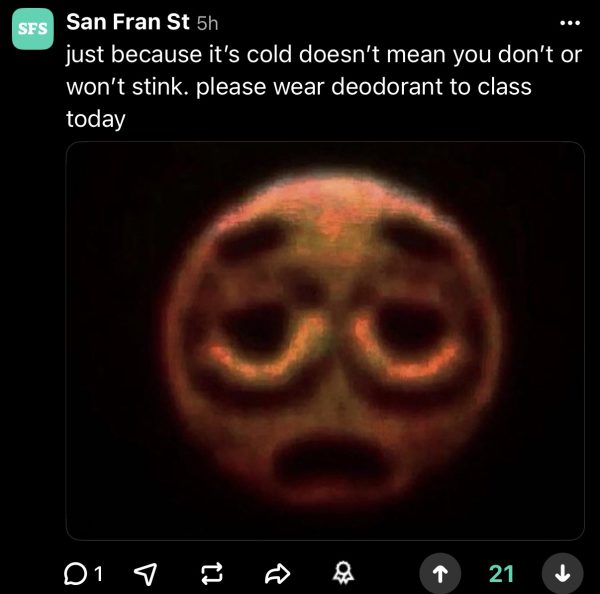
“Me and my friends, we kind of just treat it as a joke app,” said Pachori. “We would just, like, say some stupid shit on there and post it — just to, like, mess around.”
Pachori, who said he no longer uses the app, explained that while his experience wasn’t harmful, it wasn’t particularly positive or uplifting either. He found that most users use the app to express boredom, looking for something to do.
Angela Lee, a researcher at Stanford University who studies the effects of emerging media on people’s psychological wellbeing and health, explains that the combination of anonymity and locality on apps like Yik Yak creates a unique social dynamic.
“Being able to anonymously talk about things with other people in your local community can be super enhancing, ’cause it helps people feel comfortable sharing more about stuff that’s on their mind that they might not wanna have their identity tied to, and [they] also kind of get this broader sense of community.” said Lee.
But anonymity is a “double-edged sword,” Lee explains, saying that literature on social media has shown that people are more likely to engage in harmful behaviors like cyberbullying when they are anonymous.
When it comes to anonymity, Lee said, people are more likely to open up about mental health challenges or concerns about problematic supervisors, for example, when they feel like they’re not gonna be pulled out, retaliated against or judged negatively.
“But on the other hand, anonymity can also sometimes encourage people to say things that they normally wouldn’t say, in a harmful manner.”

For Jace Monti, a third-year mechanical engineering student, anonymous social media apps remind him of middle school — a time when these apps were surging in popularity.
“People can bully and say really mean, hurtful things behind the screen,” said Monti, who doesn’t use any anonymous social media apps but has seen people get hurt by them.
Other students use Yik Yak in hopes of connecting on campus, usually posting about parties or meetups at local bars. At a large commuter school like SF State with an estimated 20,000 students and beds for only around 4,000 of them, according to SF State’s housing data from Fall 2025, apps like Yik Yak can help students find community in an environment that often lacks it.
Despite using Yik Yak infrequently, first-year finance student Siu Huynh has the app to learn about what’s happening on campus, but he understands its flaws.
“With being anonymous . . . [people] are saying a lot of reckless things that could potentially ruin people’s lives,” said Huynh.
Dr. Dai To, Associate Vice President of Disability Access and Student Well-Being at SF State, explained that it can be difficult for the university to handle incidents of students’ health and safety, such as racism and bullying, when they’re anonymous. The university generally does not regulate student’s social media usage.
However, according to CSU policy, SF State is allowed to take disciplinary action for “conduct that threatens the safety or security of the campus community, or substantially disrupts the functions or operation of the University … regardless of whether it occurs on or off campus.” This applies to social media posting, including those on Yik Yak.
“Anonymity makes people bold in a way that they wouldn’t be if they had to connect their name to it,” said Dr. To. She advises students who use, and will use, the app: “to be respectful, to be kind, to not spew ugliness in the spirit of, ‘Oh, no one’s gonna see who I am,’ but to actually be a good community member.”
Although the appeal of online anonymity fluctuates on college campuses, it isn’t unique to this demographic.
“Throughout all of human history people have shared their secrets anonymously in letters, they throw a message in a bottle and hope someone reads it, or you talk to someone on the bus or a stranger at the bar,” said Lee. “People want to share what they want to know, and it’s sometimes really valuable to feel like the message you wanna share can be separated from who you are — the rest of your life.”