By 8:30 a.m., Mason Zimmerman has already placed his faith in two things: a banana and the fragile promise that today, somehow, the city won’t kill him.
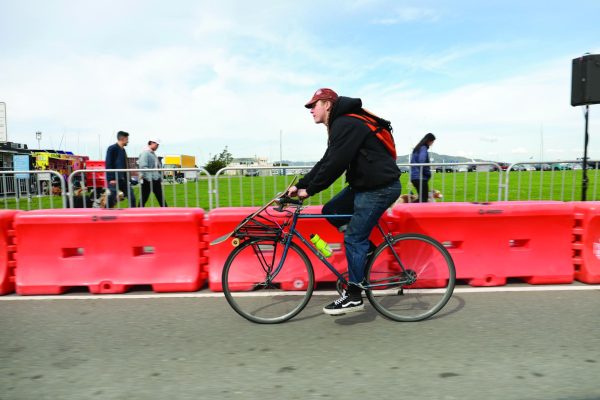
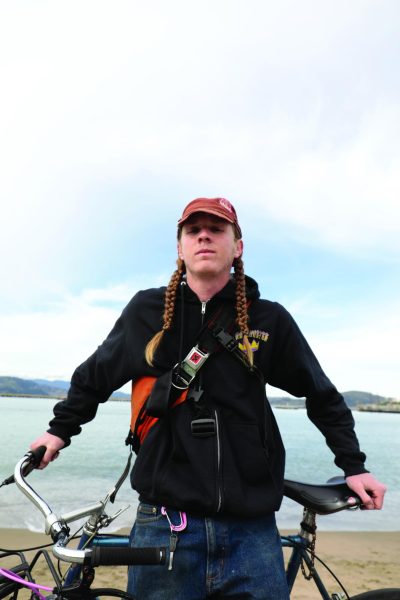
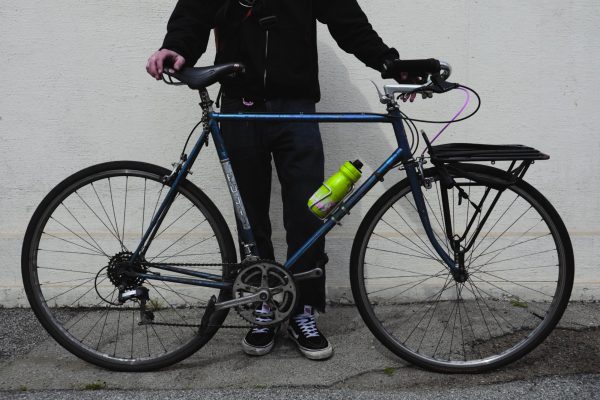
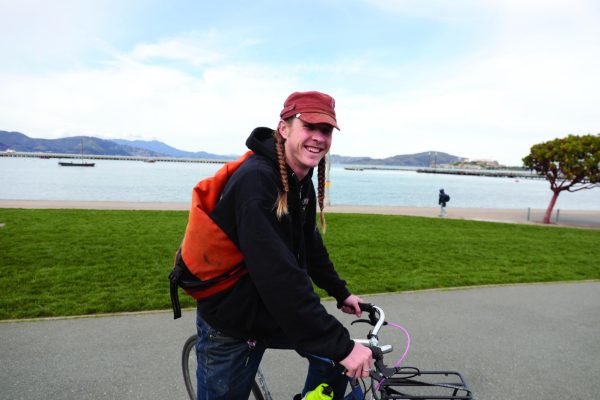
He rolls out of Embarcadero Station in a King Courier sweatshirt, an orange messenger bag slung across his back and his head on a swivel. Dodging swinging open car doors and cutting through traffic as if his bike were a knife, Zimmerman heads toward his first tag — messenger slang for a delivery.
It’s not even 10 a.m., and Zimmerman has already made 101 life-or-death decisions. The job doesn’t come with health insurance, hazard pay or the right of way. What it does offer is a street-level view of the city’s contradictions: distinct encounters often revealing the vast realities of San Francisco.
“Bike messengers are some of the only people who can literally be sitting outside at the mechanic statue at Market and Battery, sharing a cigarette with someone who lives outside, and then go to an attorney’s office, pick up court documents; be granted access into superior court,” said Ramy Silyan, the owner and operator of Stella Courier, a Bay Area-based messenger company. “And then just go right back out to being on the street with everyone.”

Bike messengers at their peak — from the late 1970s to the early 2000s — were as much a part of San Francisco’s streetscape as the steep hills and cable cars. Venture into the city’s downtown and you were almost guaranteed to come across a messenger. More often than not, they’d be riding en masse — a visible subculture with social cache. The work didn’t pay much, about $2.50 per delivery, depending on the company. But it offered steady, yet scrappy, work to those often shut out of traditional employment — immigrants and LGBTQ+ folks — or anyone wanting an alternative to a sedentary job.
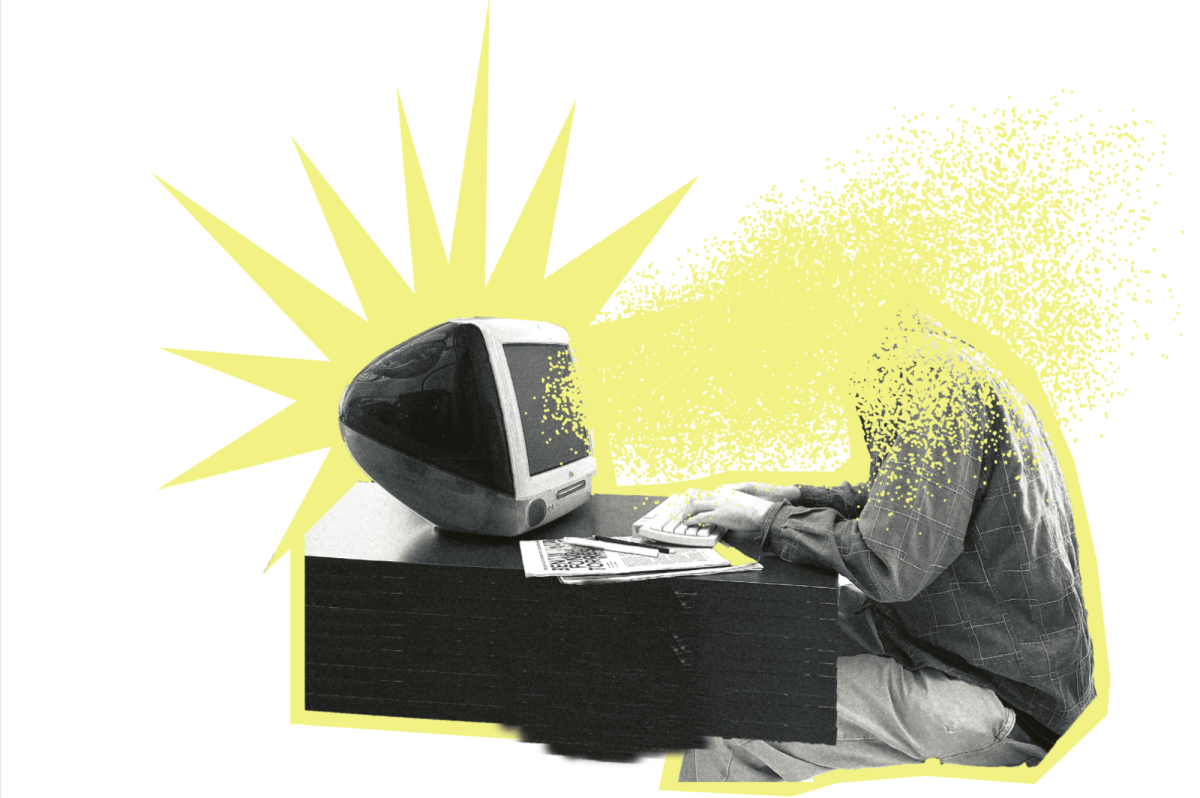
Today, the number of messengers has thinned. Emails replaced envelopes, DoorDash and UberEats superseded local food delivery companies and rising costs in the Bay Area squeezed the margins on an already precarious trade. What remains are the messengers who continue to deliver the service that can’t be replaced: personal connection.
When 73-year-old Howard Williams began messengering in San Francisco in the early 1980s — what he called the golden age of messengering — he estimated that there were at least 300 other messengers zipping through the streets alongside him.
“Whether it was an individual person or, more likely, a big business, law firm, bank, accounting firm — just about anybody downtown used messengers,” he said.
In the late 1990s, former messenger Jeremy Lacroix delivered whatever someone couldn’t afford to lose, from architectural blueprints to baby foreskin for burn victims. Lacroix found himself as a fly on the wall of a bank robbery and in circumstances he said only a fireman would witness.
“You were intrinsically tied to the heartbeat of the city when you’re on the ground, on the streets, just running into everything from, you know, going to an investment bank, talking to the receptionist, all the way through a homeless person who’s overdosing — all within minutes of each other,” said Lacroix.
Lacroix remembers messengers being a part of the visual experience in the city — but he doesn’t see that anymore.
“I saw one guy that looked like a bicycle messenger to me — one,” Lacroix said in reference to his walk home from a haircut.
Lacroix says that if he would have done that commute 30 years ago, he would have seen 40 in the same six blocks. “Now, I see a lot of scooters and motorized bikes and e-bikes. But I feel like the culture of the pedal messenger is — I think they’re like nearing extinction.”
Perhaps less visible and far fewer in numbers, bike messengers still help keep San Francisco moving. At 23, Zimmerman is one of the youngest riders in the city, while Williams, 73, ranks as second oldest in the industry. Together, they’re part of a dwindling population — approximately 50 messengers still carry the culture on two wheels, sustaining a profession that once flooded the streets of San Francisco.
Punctuated Downturns
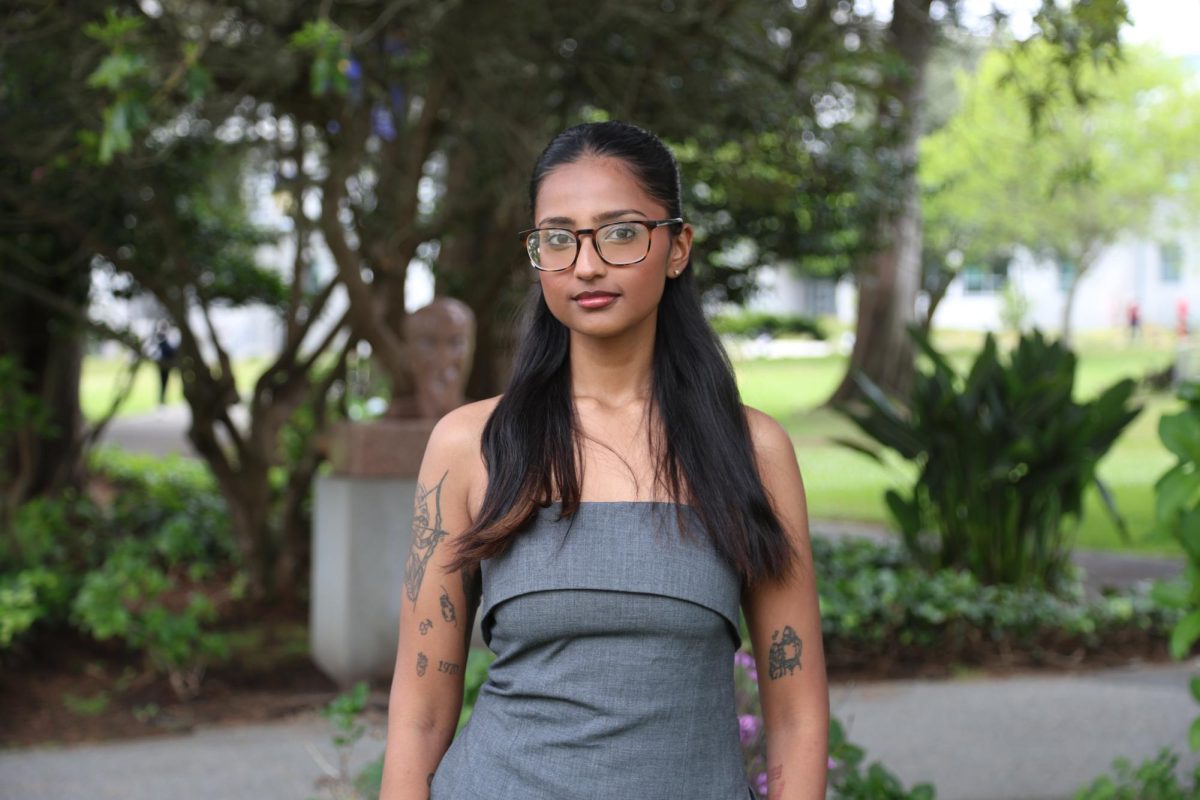
Part of the fleeting nature of the profession is what Nathalie, a 28-year-old messenger who requested to leave her full name out due to safety concerns, describes as the “punctuated downturns” — the fax machine, the internet, the 2008 financial crisis, Doordash, Uber Eats, and the coronavirus pandemic.
While the number of messenger services has dropped, Carla Laser, the current publisher of Cognition — the longest-running printed messenger zine in the world — stated in an email that some things just can’t replicate the hands-on service and expert filing provided by bike messengers.
For Silyan, this accountability has sustained messenger businesses that, in his view, corporations such as Amazon or DoorDash can’t guarantee. “When you call my office, when you call our dispatch, you’re gonna get one of the same three people,” Silyan explained. “And there’s someone there who will take care of you right away. You know, you can’t just call Jeff Bezos.”
When paying for a messenger service, the client is also paying for a messenger’s degree of personal responsibility regarding item quality assurance. “I’ve seen couriers at the clerk, the county clerk, and that superior court. They’re on the phone with their clients, with whiteout and pens, and they’re like, ‘Do you want me to fix this?’” explained Silyan.
For messengers like Williams, the day-to-day customs of the job haven’t changed much, but the model of messenger businesses have.
In the late 1990s, Williams and others helped pivot the San Francisco Bike Messenger Association into a labor-advocacy group. By the early 2000s, the San Francisco Bicycle Messenger Association (SFBMA) formed an alliance with the International Longshore and Warehouse Union Drive (ILWU). But after a few years, they parted ways.
“As the mix was useful for some companies; it did not address the majority of needs for all,” states the SFBMA mission statement, in reference to the separation between the SFBMA and ILWU. At the same time, messenger business models changed as well: “New messenger businesses formed and collectives contributed to a higher standard of fairness in messenger businesses.”
Nearly two decades later, in 2019, the community watched voters pass Assembly Bill 5, a law that makes it difficult for companies to classify workers as independent contractors rather than employees in California. This shift meant abandoning the prior model — paying messengers per delivery as independent contractors — and moving to hourly wages with employee status, explained Silyan.
While the law was intended to come down on delivery apps, it ended up impacting messenger services, for better or for worse. Silyan doesn’t know if he would ever go back to contractor-based work because of the accountability that having a staff brings.
A Penchant for Diversity
Oscar Palma — an active member of the bicycling community and someone who has reported on messengering for The Frisc and Golden Gate Xpress — points to the distinct identity that formed around the bike messenger culture in San Francisco. In the 1980s and 1990s, the bohemian lifestyle and punk ethos coexisted with bike messengering, and for Palma, made for the perfect combination.
That cross-section may be less defined after decades of punctuated downturns, but the continuity of messenger culture remains. The ethic that once attracted people living on the margins still fosters a standard of acceptance and inclusivity today.
“Typically, it’s like every [messenger] company has at least one trans woman,” said Nathalie, who is transgender. “We joke among ourselves that, ‘oh, if you’re about to pick up and move to another city, who are you going to find as your replacement?’ … There’s certainly more trans women than cis women on the road right now, at least in San Francisco.”
As someone who has experienced messengering culture from traveling across the country, Nathalie has found that there’s a current wave of trans women being messengers — the Bay Area being the epicenter of it.
Nathalie said that with trans women being some of the least employable people and facing prevalent workplace discrimination, messengering allows her to hold onto a sense of control.
Despite the shrinking pool of messengers, Silyan — who calls himself a punk from an immigrant family — still finds diversity among the messengers. “If you were to line up every single one of the messengers who are still working today, I think you would see a very diverse group of people,” he said.
Around 4 p.m., Zimmerman — along with the last messengers left in San Francisco — begins to wind down his workday with roughly 40 miles added to his tires.
“All the signs are there to shut this business down and move on,” said Silyan. “The job is hard. It’s hard on your body. Because the insurance is high, you can’t pay people what you want … But you keep doing it because you love doing it.”