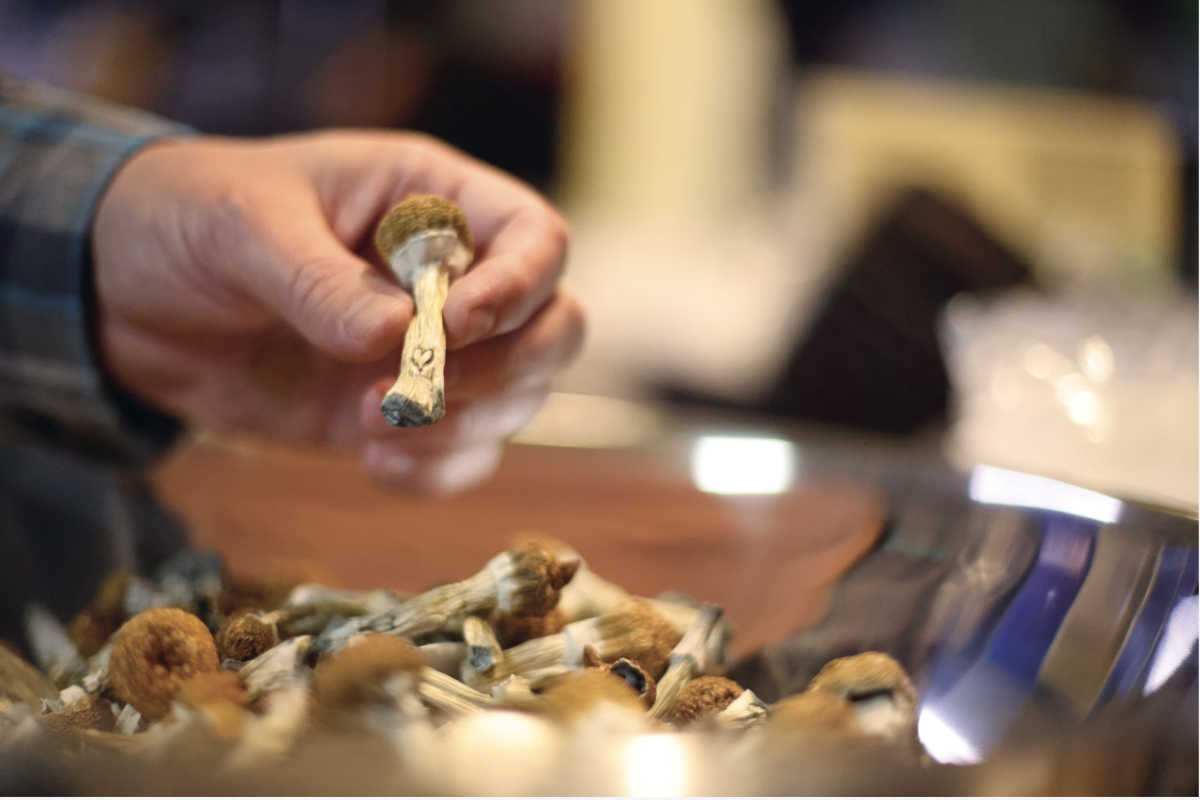
On a rainy morning in a sleepy part of the Oakland hills, Dave Hodges, founder and pastor of Zide Door — an Oakland-based church of entheogenic plants — sits in the living room of what he calls the “God Sitter House.” The house is where the church hosts guided mushroom trip sessions for members looking to break through to their soul.
Taking brief pauses to relight and take another hit of his joint, Hodges details his philosophy surrounding the use of psychoactive plants and substances, explaining how psychedelic experiences can vary depending on the doses.
He compares a microdose to a crack in the wall: “At a normal dose, it’s like poking a hole and the more you do, the larger the hole. At the breakthrough dose, it’s like taking a sledgehammer and knocking down the wall, and the first thing on the other side is your soul.”
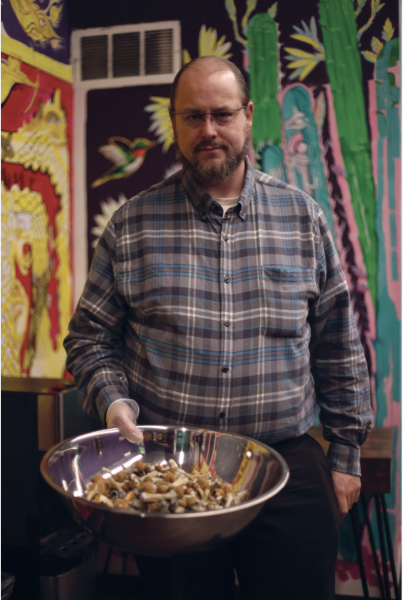
Zide Door, which has 135,000 paying members, follows the religion of the Church of Ambrosia, a nondenominational interfaith religion that believes entheogenic plants — psychoactive plants used for religious or spiritual purposes — have the ability to help people achieve profound spiritual breakthroughs.
Other psychedelic churches and temples follow the foundations of Entheoism, a religious belief system that similarly touts the power of entheogens to produce a spiritual awakening.
In California, entheogenic churches exist in a legal grey area. Despite being illegal under state law, the cities of Oakland, San Francisco, Santa Cruz, Arcata and Berkeley have decriminalized various psychedelic plants and fungi making enforcement low priority. Many of these churches cite the first amendment protection of freedom of religion as legal justification for their practices. Courts, however, are often skeptical of this defense.
But two worlds coexist in the universe of psychedelic wellbeing. For some, psychedelic healing comes as a religious sacrament and for others in the form of a prescription.
At UC San Francisco, the Translational Psychedelic Research Program studies psilocybin and other psychedelic drugs as potential treatments for mental and physical ailments. Their current studies include looking into psilocybin as a therapy for people with anorexia or Parkinson’s disease-related depression.
Xpress reached out to UCSF for comment but did not receive a response.
“I definitely take a different approach than what science does — to me this is spirituality,” said Hodges.
However, Hodges doesn’t dismiss the research done on psychedelic substances by large medical facilities like UCSF. He said that research is important in legitimizing psychedelics, specifically citing its use in end-of-life care.
Hodges explained that legalization is complicated, saying that what it should look like largely depends on the substance. He references Proposition 64, a 2016 ballot measure that legalized recreational marijuana in California. Hodges sees this as a poor example of legalization, calling the proposition “136 pages of garbage.”
“It treats cannabis like alcohol when cannabis is a fresh product,” said Hodges. “Cannabis is more equivalent to a carrot.”
Mr. Bliss, the chairman at Ritual Church, another Oakland-based mushroom church, echoed a similar sentiment as Hodges regarding medical research. But the notion of legality leaves Mr. Bliss with serious concerns over accessibility and affordability.
In Oregon, they’ve legalized psilocybin — the hallucinogenic compound in psychedelic mushrooms — to be used in supervised therapeutic sessions. Bliss says that high prices for these therapy sessions and retreats, costing as high as $3000 according to The Guardian, make it inaccessible for most.
“I don’t know any single mothers that can afford that. I don’t know any people of color — the majority of people of color — can’t afford that,” said Bliss.
Unlike psilocybin and other psychedelic drugs, ketamine is legal nationwide when prescribed by a licensed medical provider. Originally approved by the FDA as an anesthetic in 1970, it has become an increasingly common form of psychiatric treatment over the last decade. A 2023 study by EpicResearch found that prescriptions for ketamine have steadily been on the rise since 2017.
“I have been on every antidepressant on the market over the last twenty years. I get all the side effects and no benefits,” said Nick Kostesky, a user of medically prescribed ketamine. explaining this has been the first treatment that’s worked for him.
“I hit a point in my life where I was no longer able to compartmentalize and bury all the crap in my past … and over a period of years, I got to the point where I had literally tried everything else, and it was the last thing out there before I stuck a gun in my mouth and blew my brains out,” said Kostetsky.
After his monthly video appointment with his telehealth clinic, Kostetsky receives low-dose ketamine tablets via mail.
For Connor Smith, who flies from his home in Singapore to the United States to receive ketamine therapy and brings his remaining supply back home with him, the ritualistic aspect of taking the treatment is important.
“Intention is definitely important,” said Smith. “The ritualistic aspect, which ties back into ancient times … they’ve been doing this for hundreds and thousands of years.”
Smith’s experience with ketamine, particularly the aspect of intention, is a similar sentiment to what is found inside psychedelic churches. Bliss emphasizes the importance of intention, over dosage.
“I would never trust a winemaker who told me how much to drink, and I would never trust a tobacco distributor, tobacco farmer, who told me how much to smoke,” Bliss said. “I’m gonna stay within my comfort zone. I’m going to follow my history of health, and I’m going to use common sense.”
Tony Alvarez, a trip sitter and mycologist who has been working with psychedelic plants for over three decades, recognizes the benefit of clinical research but has concerns over who controls the narrative on them. He worries about accredited research institutions, like UCSF, being the only accepted source of knowledge surrounding psychedelics.
Alvarez, who is Indigenous, also worries about his culture being co-opted.
For thousands of years, Indigenous cultures have used psychoactive plants, like peyote, as sacred medicine, often consumed in ceremonies to connect with nature.
“A lot of times people who are doing the clinical work, they’re not, or have never been, interested in taking any of these medicines, as we call them,” Alvarez said. “So you can say all you want, you can bring up the data, that’s great, but if you’ve never done it, don’t even fucking speak.”