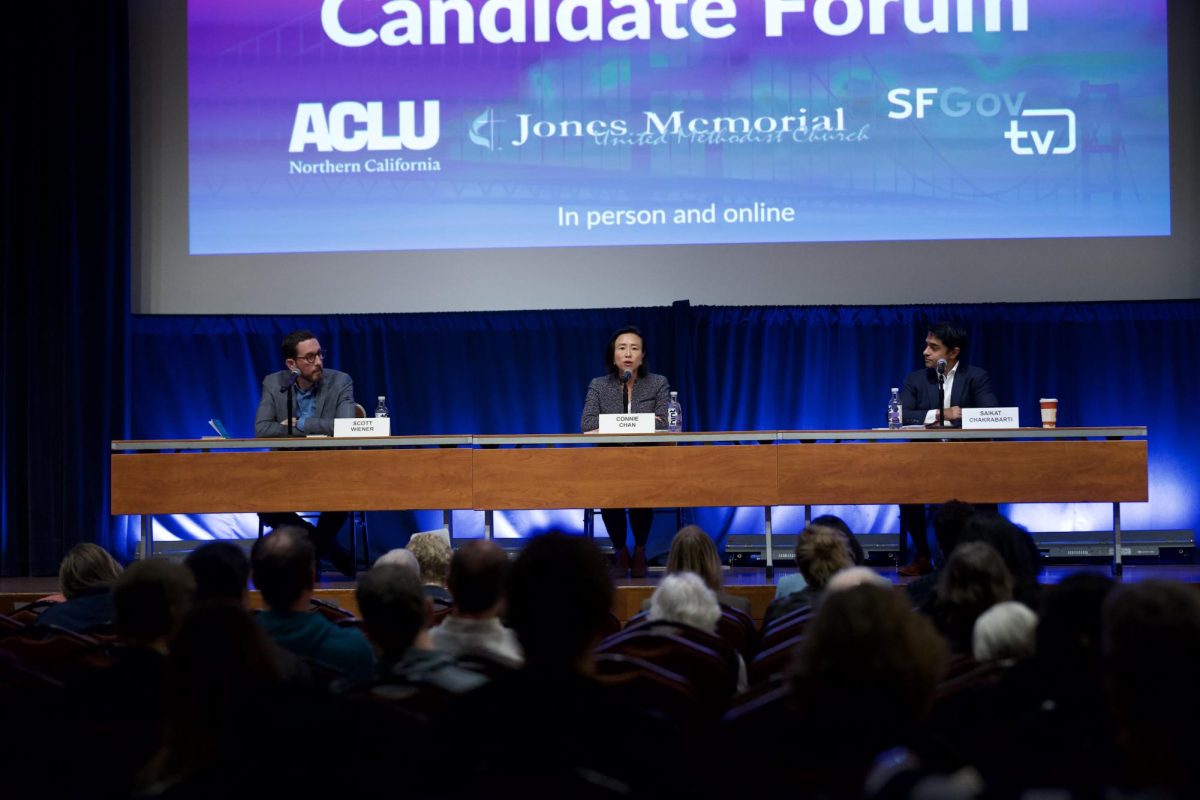
In November, San Francisco residents will vote for the 11th Congressional District candidates. Amplified pressure lies on the candidates after former Speaker of the House Nancy Pelosi is not running for reelection after 38 years of being in office.
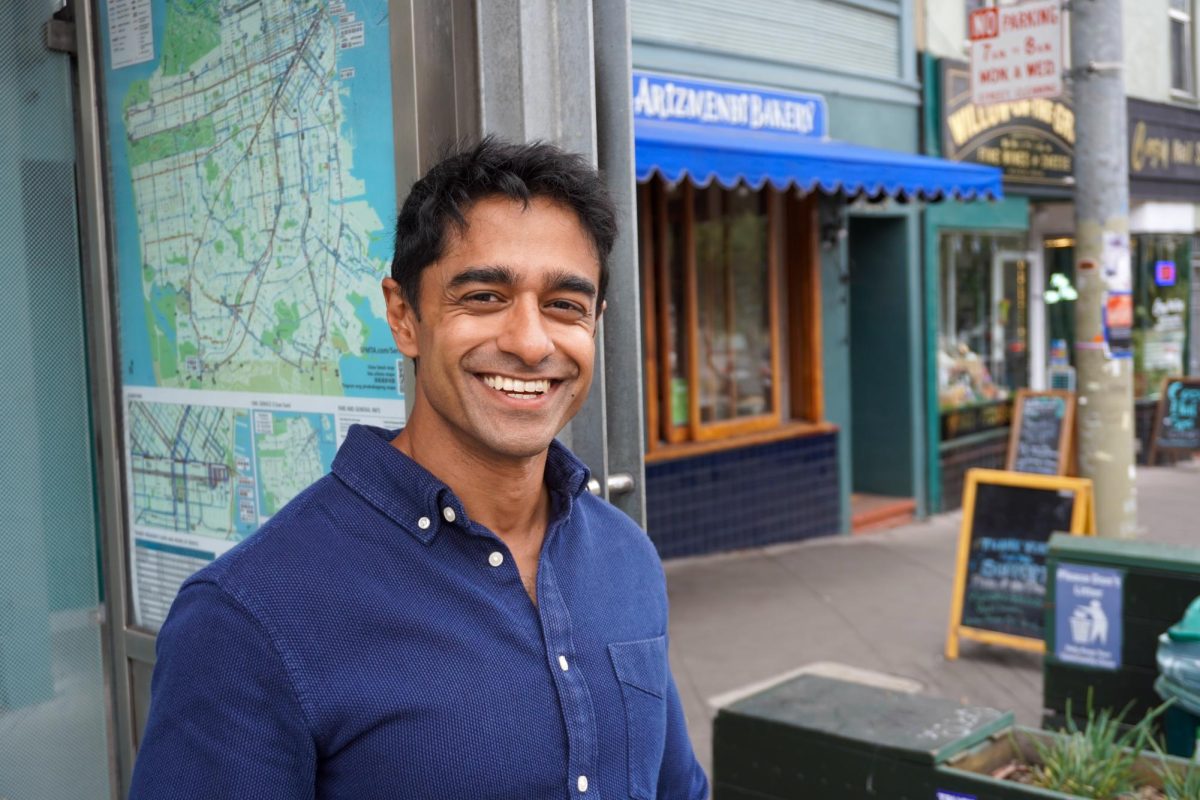
Xpress sat down with Saikat Chakrabarti — current candidate for the 11th Congressional District, former software engineer and campaign manager for Rep. Alexandria Ocasio-Cortez — to discuss certain issues facing San Francisco: a rising cost of living, a failing public transportation system and burgeoning inequality. All of this is set against a national background of fear and uncertainty with war, immigration crackdowns and concerns over the stripping of certain rights.
College students are among those facing the brunt of these issues. For them, this cluster is tangled in rent struggles, tuition and debt, all while staring down the barrel of an uncertain future.
Chakrabarti has framed his campaign around dealing with these overlapping pressures. Despite the current Democratic old guard, who are unsure of where to lead the current political moment of tension, Chakrabarti argues that this moment is the time for sweeping reform.
The following conversation has been edited and condensed for clarity.
In the U.S., San Francisco is one of the most expensive cities to live in, particularly for students who are grappling with debt, rent and tuition. What’s your plan to help students in that aspect?
Students right now are facing the worst brunt of the cost of living crisis that everybody’s facing.I think that this boils down to actually just having the government provide the essentials directly. I believe we should move towards a fully national healthcare system, similar to what they have in the Nordic countries or in the U.K. with the National Health Service. It means universal childcare. It means tuition-free public colleges and trade schools and community colleges all across the country — that’s something that would cost around $60 billion a year, which is less than how much we increased the defense budget in congress.
It also means moving to public power, so getting rid of PG&E. It means building affordable housing by having public financing and social housing in the mix. I’ve got a larger housing plan that centers around the Reconstruction Finance Corporation that could directly finance and build us housing; also, putting speculators like private equity and hedge funds out of our housing market.To actually do any of that we have to get rid of corruption in politics. I call for getting rid of the revolving door between congress and the lobbying industry. I do want to ban congressional stock trading. That is something that we see now with members of Congress who will deregulate industries where they own stocks and then they get a payout.
And then we have to actually move to a fully publicly financed election system — so just get corporate money and private money out of politics entirely. I think the larger politics I’m sort of pitching is: we’re basically in our “New Deal” moment, where there’s going to be a chance to completely change the direction and leadership of the Democratic Party, to completely change where this country is headed.
I’m glad you brought up that New Deal movement. Do you think your campaign and that broader movement is more appealing to student or younger voters?
Yeah, I think so. I see that from the voters — or the people I see showing up to our canvases, to our events, to our town halls — and I think it’s because younger voters are facing all these challenges harder than pretty much anyone. I think younger voters, just by virtue of just getting started off in our economy, don’t have a lot of wealth they can lie back on. Young voters are looking at a future where they might never be able to afford a home or afford to raise a family. At the same time, we’re seeing, with the threats of things like AI, a potential where half of all the jobs that would be available to new college grads are going to get wiped out. I think young voters are looking for solutions that are actually at the scale of the problems we’re facing, and most politicians are still pitching little reforms around the edges that clearly won’t tackle the structural issues that have led to these problems.
You built your early career around tech. There’s been, I’d say, a growing anti-tech sentiment. From your perspective, what would you say the future of the tech industry is in San Francisco? And what would you say to voters who might think twice about voting for you because of your tech background?
I talk pretty frequently about how that experience in tech was part of what led me into politics. When I first came out here to work in tech, back in 2009, I thought I’d be using technology to solve some of the big problems facing humanity, but I also realized that’s not what I was doing after a few years, seeing the cost of living go up all around me. I ended up making a lot of money. That was kind of an eye-opening experience for me, because I don’t come from money. So this is this experience of, “Yeah, I worked hard,” but I didn’t work harder than a teacher, a nurse or a janitor cleaning our offices every day. And yet, just because I hit a lottery, I could have it all while most people are not going to be able to afford a home or secure retirement ever. That seems, to me, like a completely broken system.
When it comes to the future of tech, a lot of what I see is talk around regulation. I think what we need to look at is a question of control, because what we’re seeing in our government is an oligarchy, many of them from the tech industry, trying to control our government. With AI, there’s a technology that might be wiping out half of all the jobs in this country and might even wipe out humanity itself. A few CEOs get to control that sort of huge society-wide decision for everybody else. I think the real question in the 2026 election is who controls our future? Is it going to be a handful of CEOs and billionaires and corporations and tech oligarchs, or is it going to be the people? For people who are skeptical of my tech background, look at who is funding the campaign against me right now.
Prior to this interview, we put out a poll asking people what they would like to hear from their congressional candidates. Students at SF State are very concerned about LGBTQ+ rights being taken away. What would you fight for in Congress, and how would you work to protect those communities?
We have to pass the Equality Act, which would codify protections for the LGBTQ community, especially against discrimination. Right now what we’re seeing is an assault on trans healthcare, and I think we’re going to see that expand into LGBTQ healthcare overall.
In California, there are a bunch of hospitals that are actually required by state law to provide things like gender-affirming care and trans healthcare, who are currently not because they’re afraid of the threats from the federal government and from Trump. That’s unacceptable. So in the short term, I’m going to use my position in Congress to provide the counterpressure. I’m going to threaten these hospitals with legal action, with oversight — bring their CEOs in front of committee hearings, in front of Congress — to create the pressure to get them to provide trans healthcare and LGBTQ healthcare and not cave to Donald Trump.
But in the long run, that’s going to mean making sure that when we do pass “Medicare for All,” that Medicare for All really is Medicare for all: That means we cover trans healthcare, LGBTQ healthcare, as part of a universal healthcare system.
SF State’s a commuter school where the vast majority of students don’t live on campus. A lot of them rely on public transportation. What would you do to help BART and Muni stop these major cuts that they’re considering?
My plan calls for allowing us to use just a small fraction of highway expansion money to fully fund not just BART and Muni but public transit all across the country. I also want to make sure we use that money not just for capital expenses, which is what’s legal right now, but for operating expenses as well.
That’s going to let BART and Muni basically have the confidence to know that they have this long-term money and then they can make capital expenses to actually expand bus lines; expand train lines. And the thing is, the money is there. We see [U.S. Secretary of War] Pete Hegseth is asking for around $200 billion for war in Iran. If we wanted to fully fund all public transit in the country, that would cost $7 billion. It’s a tiny fraction of what they’re asking for. So, the money’s there, it’s just a question of priorities. The way you fix those priorities is you replace not just Republican politicians but also a lot of Democratic politicians, who’d rather have us keep spending money on bombs and war than spending money to just fix public transit right here.
You have been very critical of U.S. foreign policy to Israel. What would you do if elected to reshape that policy?
The first step is no more military funding to Israel — at all. I would vote to stop all military funding to Israel, but I’d also organize a caucus of us who are going to hold the line on major bills to make sure we don’t keep sending money there. This is an issue where the vast majority of people actually agree that we shouldn’t be sending more money to Israel at a time when people can’t even afford healthcare or housing in our own country. The vast majority of politicians don’t agree. The reason for that is you look at who’s donating to their campaigns. You still have the American Israel Public Affairs Committee (AIPAC) and a huge Israel lobby putting in tens of millions of dollars, if not hundreds of millions of dollars, into elections to make sure that our politicians continue voting to send money to Israel. It would require not just me as a legislator voting the right way, but I will also be recruiting and supporting candidates who are primarying AIPAC-backed candidates all across the country to replace them so that we can actually have a majority in Congress that reflects the will of the people.
San Francisco has sort of managed to avoid a lot of the major U.S. Immigration and Customs Enforcement (ICE) takeovers other cities, like Minneapolis and Los Angeles, have seen. But there’s still anxiety among many immigrant communities. What would you do to prevent these major immigration crackdowns?
As a member of Congress, I will show up when ICE shows up in our city, especially if they’re trying to come do a mass push. I believe members of Congress have a role to play that’s beyond just being a legislator: We should be organizers in this moment. That means if ICE shows up, we show up and we confront them. We have to abolish ICE. I think the way to even get started on that, even when Trump’s still president, is whenever we have a government budget that’s about to be passed, we don’t vote on it until we claw back the extra money that’s been given.
I think the Democrats, in my view, do not know how to use these budget fights to actually win public opinion, which is how you have to actually win these budget fights. We saw after Alex Pretti got murdered, there was this moment where the entire country was watching and was very upset with what ICE had just done. At that same moment, there was a U.S. Department of Homeland Security funding bill going through the House and the Senate. That would have been the time for Democrats to actually hold the line on clawing money back from ICE. Instead, what they did was they passed a two-week temporary funding measure and, by the time two weeks was up, the rest of the country’s not paying attention anymore. So we have to actually learn how to use the attention economy, hold attention and use that to win fights on issues.
In recent years, CSUs have been dealing with a very unstable budget. What would you do to help fund higher education and make sure that students are getting the education they’re paying for?
I think the federal government should directly fund CSU and all public colleges, and trade schools and community colleges. This would be somewhere between $60 and $80 billion a year. That is an amount that is often less than the amount that we increase the military budget by. So we absolutely have the money to do it. In Congress, I’ll work to create a permanent operating fund to directly fund our public colleges to make sure CSUs are fully funded forever.